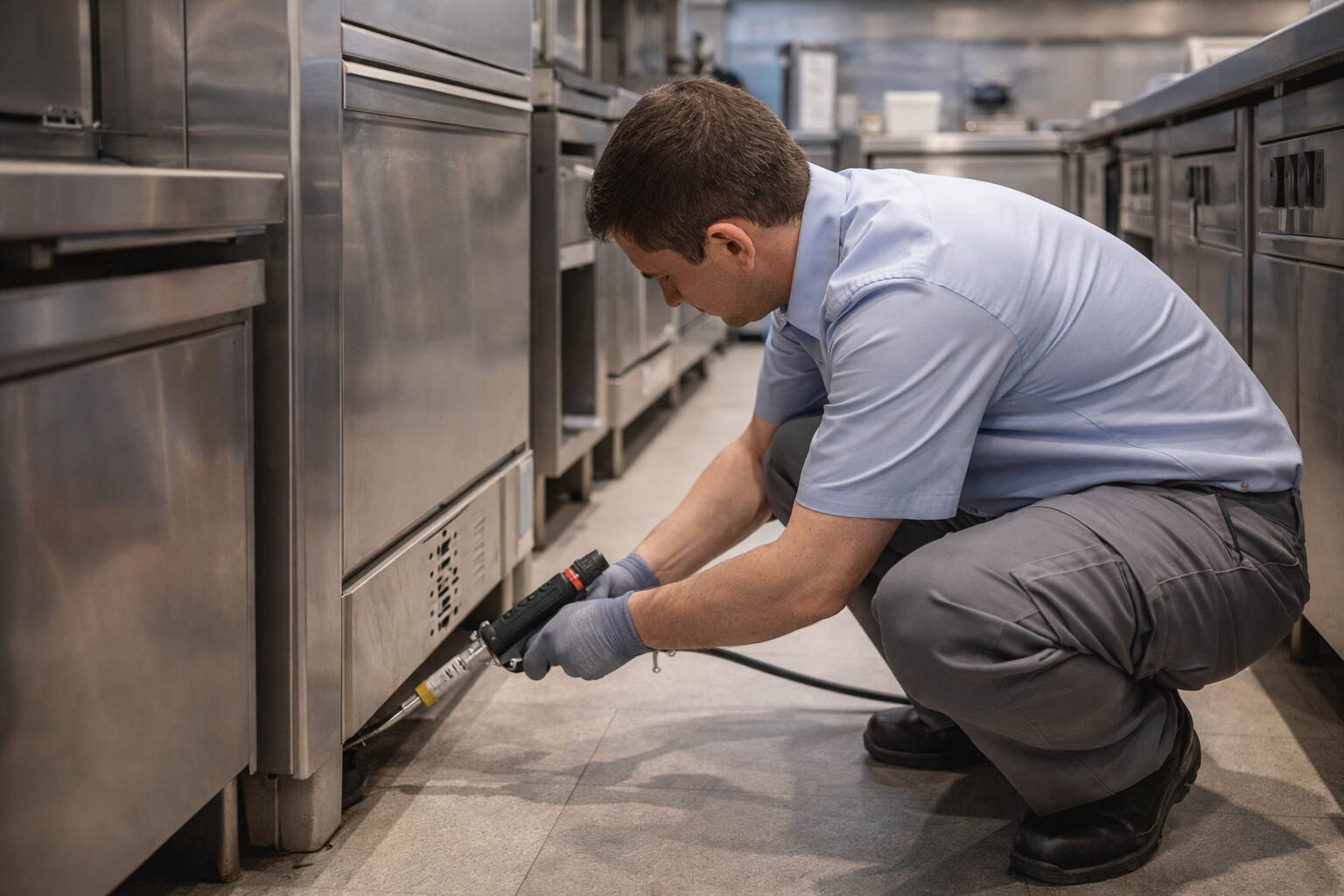
All Dubai restaurants must use only DM-licensed pest control contractors — DIY does not meet compliance requirements.
Monthly treatment of kitchen and food preparation areas is mandatory under Dubai Food Code standards.
DM requires digital contractor registration via the FoodWatch Supplier Management system.
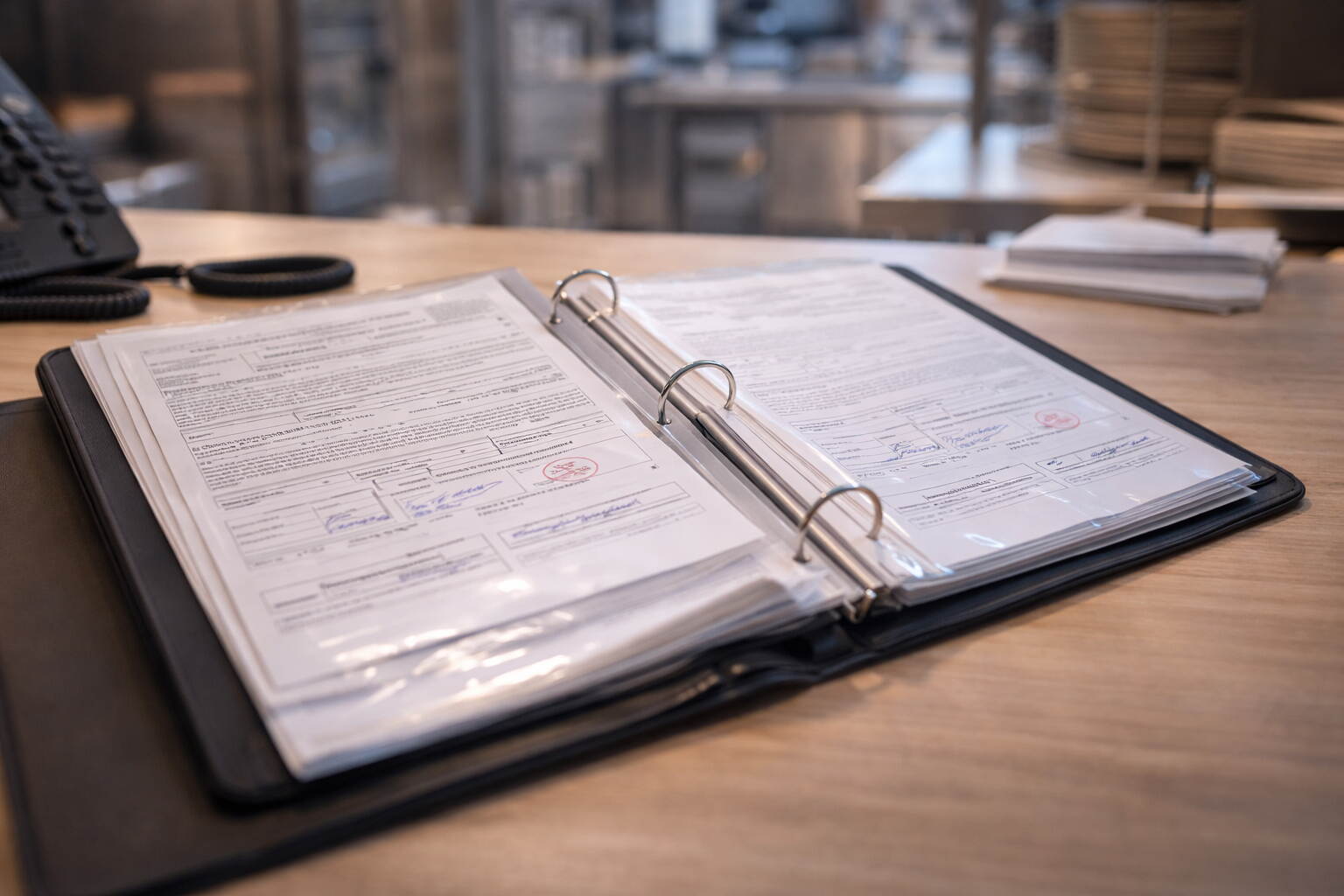
Treatment certificates must be kept on-site and must include specific fields to pass a DM inspection.
Gaps in your pest control records — even a single missing certificate — can trigger compliance action.
Dubai Municipality pest control requirements for restaurants are among the most
strictly enforced food safety rules in the UAE. Whether you run a café in JLT,
a hotel kitchen in Downtown, or a cloud kitchen in Al Quoz, your premises must
meet Dubai Food Code standards for pest management at all times. Furthermore, DM
inspectors check pest control compliance as part of every routine food safety
inspection. Gaps in your records, an unlicensed contractor, or a missing treatment
certificate can each result in fines, permit suspension, or temporary closure of
your business.
This guide covers exactly what DM requires, what inspectors look for during a visit,
and how to structure your pest control programme to stay fully compliant year-round.
Additionally, it includes the treatment frequency standards by zone and a complete
compliance checklist you can use before your next DM inspection.
What Dubai Municipality Requires for Restaurant Pest Control
The Legal Basis — Dubai Food Code 2.0 and Public Health Regulations
Dubai Municipality's Food Code 2.0 is the primary regulatory
document governing pest management in all food handling premises. It requires every
food business to implement an Integrated Pest Management (IPM) programme. This must
form a documented, verifiable part of your food safety management system — not simply
an informal arrangement with a local technician.
Additionally, the Public Health Pest Control Section of DM's Public
Health Services Department oversees the licensing of all pest control contractors in
Dubai. Only companies on DM's approved contractor list are permitted to provide pest
control services to food premises. Consequently, using a contractor who is not on
this list — even if they use approved chemical products — constitutes a compliance
violation in its own right.
Which F&B Businesses Must Comply
DM pest control compliance requirements apply to every business that handles, prepares,
stores, or serves food in Dubai. This includes restaurants, cafés, hotel restaurants
and banqueting kitchens, catering companies, food trucks, cloud kitchens, bakeries,
supermarket food preparation areas, and any workplace canteen with a cooking facility.
Moreover, the requirements apply regardless of business size — a ten-seat café carries
the same pest control obligations as a five-star hotel kitchen.
In contrast, food retail units that do not prepare food — such as packaged goods
stores — still require pest control management, but the minimum frequency standards
are applied differently based on risk level. For all full-service food preparation
premises, however, monthly treatment of kitchen areas is the baseline requirement.
The FoodWatch Supplier Management System
A requirement that many restaurant owners overlook is the FoodWatch Supplier
Management System. Dubai Municipality requires all food businesses to register their
pest control contractor digitally via the
FoodWatch portal.
This means the relationship between your restaurant and your pest control company
must be formally recorded in DM's system — not just confirmed by a paper contract.
Therefore, simply having a signed service agreement with a DM-licensed contractor
is not sufficient by itself. Your contractor must also be linked to your premises
within the FoodWatch platform. Ask your current pest control provider whether this
registration is in place. If it is not, request that they complete the FoodWatch
supplier registration before your next scheduled treatment visit.
What DM Inspectors Check During a Food Safety Visit
Understanding what a DM inspection involves helps you maintain ongoing compliance
rather than scrambling before a known visit. DM food safety inspections are not
always announced in advance — routine inspections and complaint-triggered visits
both occur, and your premises must be inspection-ready at all times.
How Inspections Are Triggered
DM food safety inspections fall into two main categories. Routine inspections
are scheduled periodically for all licensed food premises — the frequency depends on
your premises risk classification. Complaint-triggered inspections occur
when DM receives a report of food safety concerns, including pest sightings reported by
customers or neighbouring businesses. Furthermore, inspections can also follow permit
renewals or changes in ownership. In all cases, you should treat your premises as
inspection-ready every day of the year.
What the Inspector Examines On-Site
During a food safety inspection, the DM inspector checks pest control compliance
across three areas. First, they review your documentation — your
treatment certificate file, your FoodWatch contractor registration, and your pest
activity log. Second, they inspect physical conditions — looking for
evidence of live pest activity, droppings, structural entry points, and harborage
zones. Third, they verify contractor details — confirming that
your pest control provider holds a current DM licence.
Similarly, inspectors check that treatment certificate fields are complete and
correctly filled. A certificate that lists only "pest control treatment" without
specifying chemicals, technician ID, or treatment method does not satisfy DM's
documentation requirements — even if the treatment itself was carried out correctly.
Penalties and Consequences for Non-Compliance
DM can issue compliance notices ranging from advisory warnings to formal financial
penalties, depending on the severity and history of the violation. A first documentation
gap typically results in a formal warning and a deadline to produce compliant records.
However, evidence of live pest activity in a food preparation or service area carries
significantly heavier consequences. Inspectors can issue immediate closure notices for
serious active infestations — particularly rodents or cockroaches in a customer-facing
or food contact zone. Repeat violations compound penalties substantially.
For current penalty structures and the official DM food safety compliance framework,
refer to the
DM Public Health Pest Control Section
and the DM Food Safety portal, where guidelines are updated regularly.
⚠️ Critical Compliance Note: FoodWatch Registration Is Mandatory
Many restaurant owners discover only during an inspection that their contractor is
not registered in the FoodWatch Supplier Management system — even though the
contractor holds a valid DM licence. These are two separate requirements. Your
contractor being licensed does not automatically register them against your premises
in FoodWatch. Confirm both before your next scheduled visit.
Treatment certificates from every pest control visit must be filed on-site and available for immediate DM inspector review — missing a single certificate constitutes a compliance gap.
The 6 Core DM Pest Control Requirements for Dubai Restaurants
The six requirements below represent the practical framework DM expects every food
premises to maintain. Each one relates directly to what an inspector checks during
a food safety visit. Meeting all six consistently is the difference between a
compliant premises and one that faces enforcement action.
Requirements 1–3: Contractor Licensing, FoodWatch Registration, and Approved Chemicals
1
Use Only a DM-Licensed Pest Control Contractor
Dubai Municipality requires all food premises to engage pest control services
exclusively from a DM-approved contractor. The Public Health Pest Control Section
maintains a current list of approved companies. Your contractor's DM licence
number must appear on every treatment certificate they issue. DIY pest control
— even using DM-approved products — does not satisfy this requirement. Verify
your current contractor's licence status at
dm.gov.ae
before signing or renewing any contract.
2
Register Your Contractor via FoodWatch
Beyond holding a DM licence, your contractor must be digitally registered
against your premises through the
FoodWatch Supplier Management System.
This is a separate step from contractor licensing. Many restaurants have faced
DM compliance issues because their licenced contractor was never linked to their
premises in FoodWatch. Confirm this registration is in place before your next
inspection — ask your contractor to provide confirmation that the FoodWatch
supplier link is active for your premises.
3
Apply Only DM-Approved Chemical Products
Dubai Municipality maintains an approved register of pesticides licensed for
use in food handling premises. Your contractor must use only products from
this approved list — no exceptions. Each treatment certificate must specify
the active ingredient, brand name, concentration, and volume applied. If an
inspector finds evidence of unapproved chemicals on your premises, you face
immediate compliance action. Furthermore, insist that your contractor provides
a chemical register before each treatment visit so you know exactly what is
being applied in your kitchen.
Requirements 4–6: Treatment Frequency, Documentation, and Pest Reporting
4
Meet Minimum Treatment Frequency Standards by Zone
Monthly pest control treatment of kitchen and food preparation areas is the
DM-mandated minimum frequency for all Dubai restaurant premises. Bin rooms,
refuse areas, and drain zones also require monthly treatment due to their
high pest activity risk. Storage areas and service corridors require bi-monthly
to quarterly treatment depending on their proximity to food handling zones.
Your service contract must reflect these frequencies by zone — a single annual
or quarterly flat-rate visit plan does not meet DM requirements for a working
restaurant kitchen.
5
Maintain Complete Treatment Certificates On-Site
Every pest control visit must produce a signed treatment certificate. DM
inspectors expect original copies held on-site and immediately available for
review. Each certificate must include: the treatment date and time; the
technician's full name and DM authorisation card number; the specific
pesticide(s) used with active ingredient, brand name, concentration, and
volume; the treatment method (gel bait, residual spray, ULV, etc.); and any
pest activity or structural defects noted. A certificate missing any of these
fields does not satisfy DM inspection requirements — even if the treatment
itself was conducted correctly.
6
Log All Pest Activity and Maintain Emergency Call-Out
Your pest control programme must include a formal pest activity log. Document
every pest sighting between scheduled visits — including date, location, species
observed, and the follow-up action taken. DM inspectors often request this
log alongside treatment certificates. Moreover, your service contract must
include a defined emergency call-out response time. Live pest sightings in
customer-facing or food contact areas require immediate contractor response —
confirm a 24-hour call-out commitment is documented in your written service
agreement, not just verbally assured.
Monthly treatment of kitchen and food preparation zones by a DM-licensed technician — with a treatment certificate issued after every visit — is the core of Dubai restaurant pest control compliance.
✅ Dubai Municipality Pest Control Compliance Checklist for Restaurants
Contractor holds a valid DM licence — verify the licence number at dm.gov.ae before signing any contract
FoodWatch registration confirmed — contractor is digitally linked to your premises in the FoodWatch Supplier Management system
DM-approved chemicals only — request the chemical register from your contractor before each treatment visit
Monthly kitchen treatment — food preparation zones, cooking lines, and bin rooms receive monthly scheduled visits
Treatment certificates on-site — complete, signed originals available for immediate DM inspector review
All certificate fields complete — technician DM ID, chemical details, treatment method, and pest activity notes all present
Pest activity log maintained — every sighting between scheduled visits is documented with date, location, and follow-up
Structural defect records — contractor notes entry points and management acts on them within an agreed timeframe
24-hour emergency call-out confirmed in writing — live pest sightings require immediate documented contractor response
Annual licence renewal checked — request an updated contractor certificate every year to confirm ongoing DM approval
Need a DM-licensed pest control partner to keep your restaurant fully compliant? Our team provides monthly treatments, compliant certificates, and FoodWatch registration support.
How to Choose the Right DM-Licensed Pest Control Provider
Treatment Frequency Reference by Zone
Before evaluating providers, confirm that your shortlisted contractors propose
a treatment plan that matches the DM frequency requirements for each zone in your
premises. The table below provides a practical reference for standard Dubai
restaurant and hotel kitchen environments. Use it when reviewing any pest control
proposal or existing contract.
Premises Zone
Pest Risk Level
Minimum Treatment Frequency
Kitchen & Food Preparation Areas
Very High
Monthly
Bin Rooms & Refuse Areas
Very High
Monthly
Dining Areas & Service Stations
High
Monthly
Dry Storage & Receiving Areas
High
Monthly
Cold Storage & Walk-In Refrigeration
Medium
Bi-monthly
Staff Areas & Locker Rooms
Medium
Bi-monthly
Service Corridors & Back-of-House
Medium
Bi-monthly
Outdoor Terraces & Loading Bays
Low–Medium
Quarterly
Four Things to Verify Before Signing a Pest Control Contract
🏛️
Verify the DM Licence Before You Sign
Request the contractor's DM licence number and verify it directly at dm.gov.ae before signing any contract. A licence that lapsed three months ago is as legally invalid as no licence at all. Many restaurants discover mid-contract that a contractor's licence expired without notification — request annual renewal confirmation in writing.
📋
Review the Treatment Certificate Format First
Ask any shortlisted provider to share a sample treatment certificate from a live contract. A compliant certificate includes: DM licence number, technician name and authorisation card number, chemical products by active ingredient, treatment method, and pest activity notes. Reject any provider whose sample certificate is missing these fields.
📝
Insist on a Written Zone-by-Zone Service Contract
Your pest control agreement must be in writing and must specify treatment frequency by zone, chemicals to be used, emergency response time, and exactly what documentation you receive after each visit. A verbal arrangement with a technician offers no legal protection during a DM food safety inspection.
⚡
Confirm 24-Hour Emergency Call-Out in Writing
Live pest sightings in a kitchen or customer-facing area require immediate documented response. Confirm that your contractor provides genuine 24-hour emergency call-out across Dubai with a defined response time. Get this commitment in writing in your service contract — not as a verbal promise at the point of sale.
Reviewing your pest control contract carefully before signing — including treatment frequencies by zone and emergency response terms — protects your DM compliance position year-round.
What Supernova Provides for Dubai Restaurant Clients
Supernova Pest Control provides commercial pest control services
specifically designed to meet Dubai Municipality's food safety requirements. Every contract
includes monthly kitchen treatment, DM-approved chemical products, and fully compliant
treatment certificates issued after each visit — with all required fields completed as
standard.
For restaurant groups, hotel operators, and catering companies managing multiple sites,
our annual pest control contracts
cover all premises under a single agreement with consolidated reporting — simplifying
your DM compliance across every location. Additionally, our team can help confirm your
FoodWatch supplier registration is correctly in place for all covered premises.
For more information on our full service range, visit our
pest control Dubai page.
Frequently Asked Questions
Does every restaurant in Dubai need a pest control certificate?
Yes — all food handling premises in Dubai must maintain valid pest control records
under Dubai Municipality's Food Code requirements. This includes restaurants, cafés,
hotels, catering companies, cloud kitchens, and any business with a commercial kitchen.
DM inspectors check pest control compliance as a standard part of every food safety
inspection. Failure to produce compliant records can result in fines, permit suspension,
or temporary closure.
How often must a Dubai restaurant receive pest control treatment?
Kitchen and food preparation areas require monthly treatment as a minimum under
Dubai Municipality's Food Code. Bin rooms and refuse areas also require monthly
treatment due to their high pest risk. Cold storage, service corridors, and staff
areas typically require bi-monthly treatment. Outdoor terraces and loading bays
may be treated quarterly depending on risk assessment. Your service contract must
specify frequency by zone — a single flat-rate visit plan for the entire premises
does not meet DM requirements.
What happens if my restaurant fails a DM pest control inspection?
DM inspectors can issue compliance notices ranging from advisory warnings to formal
financial penalties. A first documentation gap typically produces a formal warning
and a deadline to produce compliant records. Evidence of live pest activity in a
food preparation or customer-facing area carries significantly heavier consequences —
including immediate closure notices for serious infestations. Repeat violations across
multiple inspections compound penalties substantially. For current penalty structures,
refer to the DM Food Safety portal.
Can I use any pest control company for my Dubai restaurant?
No — Dubai Municipality requires all food premises to engage only DM-approved
pest control contractors. The contractor's DM licence number must appear on every
treatment certificate. Using an unlicensed company — even one applying approved
chemical products — constitutes a compliance violation. Additionally, your contractor
must be registered against your premises in the FoodWatch Supplier Management system.
Verify any contractor's DM approval directly at
dm.gov.ae
before signing a contract.
What must be included on a DM-compliant treatment certificate?
A DM-compliant treatment certificate must include: the treatment date and time;
the technician's full name and DM authorisation card number; the specific
pesticide(s) used by brand name, active ingredient, concentration, and volume
applied; the treatment method (gel bait, residual spray, ULV, etc.); any pest
activity observed; any structural defects noted; and the contractor's DM licence
number. Certificates missing any of these fields do not satisfy DM inspection
requirements — even if the treatment itself was correctly performed.
What is the FoodWatch Supplier Management system and why does it matter?
The FoodWatch Supplier Management system is Dubai Municipality's digital platform
for registering food business suppliers — including pest control contractors.
DM requires restaurants to formally link their pest control provider to their
premises within FoodWatch. A contractor holding a valid DM licence is not
automatically registered against your specific premises — this is a separate step.
Many restaurants discover this gap only during a DM inspection. Confirm your
contractor's FoodWatch registration at
foodwatch.dm.gov.ae.
How do I get a DM pest control certificate for my restaurant?
A pest control certificate is issued by your DM-licensed contractor after each
completed treatment visit — there is no separate DM certificate you apply for
directly. Compliance is demonstrated through the ongoing file of treatment
certificates your contractor produces throughout the year. Ensure your contractor
issues certificates with all required fields completed after every visit. Store
all originals on-site in a dedicated compliance file. For an
annual contract
that includes monthly treatments and compliant certificates as standard, contact
Supernova Pest Control.
Does DM pest control compliance apply to hotel restaurants and cloud kitchens?
Yes — Dubai Municipality's Food Code applies to all commercial food handling
premises regardless of format. Hotel kitchens, banqueting facilities, room service
operations, cloud kitchens, and food delivery preparation units are all subject
to the same pest control requirements as standalone restaurants. Furthermore,
hotel operators managing multiple food outlets across a single property must ensure
each outlet has compliant pest control records — a single site-wide contract may not
satisfy zone-specific treatment frequency requirements for all areas. Our
commercial buildings service
covers multi-outlet hotel and hospitality properties.
🦟
Supernova Technical Team
Supernova Pest Control is a Dubai Municipality-licensed pest management company
serving restaurants, hotels, and commercial properties across all Dubai communities.
Our technical team has over ten years of experience providing DM-compliant pest
control programmes for the UAE's food and beverage sector. For full service details,
visit our pest control Dubai page.