Dubai Municipality requires pre-construction anti-termite soil treatment before any concrete slab is poured on new builds and fit-outs.
The critical treatment window opens after excavation reaches final design depth and closes the moment blinding concrete is placed — it cannot be recovered once missed.
Under Dubai Local Order No. 11 of 2003, the main contractor — not the pest control subcontractor — bears legal liability for adequate treatment.
Only products on Dubai Municipality's approved pesticides list are valid — non-approved termiticides will fail inspection and void the completion certificate.
An annual maintenance contract is required before handover to preserve the termiticide warranty and satisfy DM's ongoing pest control requirements.
This pre-construction anti-termite guide covers everything Dubai developers and site managers need to protect a new building — starting before the first slab is poured. Subterranean termites cause serious structural damage to UAE buildings every year. Furthermore, Dubai Municipality makes pre-construction soil treatment a mandatory step in the building permit process. Miss the treatment window and you face DM non-compliance, costly remedial work, and delays to your Occupancy Certificate. This guide explains the legal framework, the six treatment stages, the DM-approved chemicals, and how to select the right licensed contractor in Dubai.
Why Termites Are a Construction-Stage Risk in Dubai
The Subterranean Termite Threat in UAE Soil
Dubai and the broader UAE face ongoing pressure from subterranean termites — primarily Coptotermes gestroi and related species. These termites live in underground colonies and forage upward through the soil. Consequently, they enter buildings from below — exploiting expansion joints, service penetrations, and foundation cracks that are invisible from the surface. The UAE's warm sub-surface soil maintains consistent moisture at depth even during dry surface conditions. This creates near-ideal conditions for year-round colony activity directly beneath construction sites.
Sandy soil — which covers most Dubai development zones — presents an additional challenge. Termites travel more easily through loose sand than through dense clay. Moreover, sandy soil drains termiticide applied at standard rates much faster than in other climates. As a result, pre-construction treatment in Dubai requires higher application volumes per square metre than standard international guidelines recommend.
The Critical Treatment Window Before the Slab
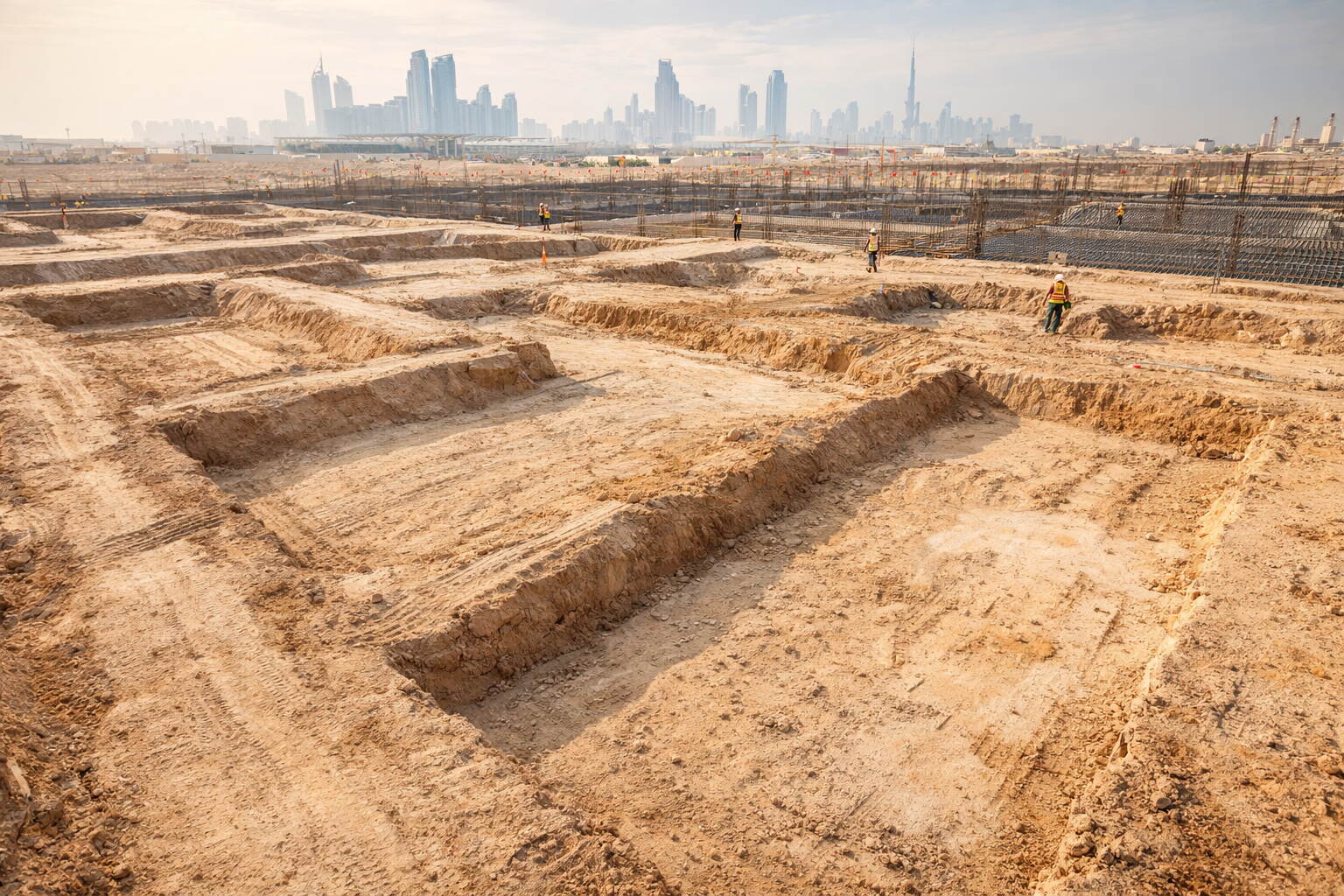
The most important moment in any construction project is the period after excavation reaches final depth and before the concrete slab is poured. This is the only opportunity to apply termiticide directly to the building footprint's base soil. Once the slab is in place, treatment can only reach the perimeter. The sub-slab soil becomes permanently inaccessible. Therefore, the pre-slab treatment window is irreversible: miss it and no remedial measure can replicate it.
Additionally, blinding concrete — the thin layer poured before structural rebar — closes the window permanently. Treatment must be complete and cured before any concrete, even blinding, is placed on the treated area. This means the pest control contractor must be mobilised and ready at the exact moment excavation reaches final depth. Poor site programme coordination is the primary reason this window is missed on Dubai construction projects.
What Happens When Treatment Is Skipped
Buildings constructed without pre-slab anti-termite treatment in Dubai's high-risk soil zones typically show termite ingress within two to five years. Subterranean termites establish foraging channels through sub-slab voids and attack timber flooring, door frames, built-in joinery, and structural timber elements. Furthermore, internal damage often goes undetected until it is extensive — because subterranean termites consume wood from the inside out, leaving surfaces intact.
Beyond structural damage, there is a significant regulatory consequence. Dubai Municipality will not issue a final building completion certificate without a valid anti-termite treatment certificate. Consequently, a developer who skips treatment faces both a structural risk and a building permit closure problem at the same time.
Dubai Municipality Requirements for Anti-Termite Treatment
Dubai Local Order No. 11 of 2003 — Contractor Liability
Under Dubai Local Order No. 11 of 2003, the main contractor on any construction project is legally responsible for pest control throughout the build programme. This responsibility explicitly includes pre-construction anti-termite soil treatment. Moreover, the Order places liability on the main contractor — not the pest control subcontractor — if treatment is inadequate, incorrectly timed, or omitted entirely.
In practice, this means main contractors must ensure their pest control subcontractor is DM-licensed, uses only approved products, treats the full footprint before slab pour, and issues a valid completion certificate. Furthermore, the contractor must retain all treatment records for the full duration of the building's warranty period. These records form part of the handover documentation package.
DM-Approved Chemicals — What You Can and Cannot Use
Dubai Municipality maintains an approved list of pesticides for anti-termite soil treatment. Only products on this list are valid for pre-construction applications in Dubai. Products removed from the approved list in previous review cycles — regardless of their historical effectiveness — are no longer acceptable under any circumstances.
Currently approved formulations for soil termite treatment include synthetic pyrethroid-based products and phenylpyrazole-based products, applied at DM-prescribed rates per square metre. However, the approved list is reviewed and updated periodically. Therefore, always verify the specific product's approval status directly with Dubai Municipality's Public Health department before treatment commences. A contractor who cannot provide the product's DM approval certificate number should not be appointed.
⚠️ DM Compliance Tip
Before treatment begins, request the product data sheet and the DM approval certificate number for the termiticide your contractor intends to use. If the product is not current on Dubai Municipality's approved pesticides list, the treatment is invalid — regardless of how well it was applied. An invalid product means a failed DM inspection, no completion certificate, and a blocked building permit closure.
The Completion Certificate and Building Permit Sign-Off
The anti-termite completion certificate is issued by the DM-licensed pest control contractor after a successful treatment and inspection. This certificate is one of several NOCs required to close the building permit and progress to the Occupancy Certificate stage. Without it, Dubai Municipality, Trakhees, and DDA building departments will not issue final building approvals.
The certificate must identify the product used, the application rate, the treatment date, the area treated in square metres, and the contractor's current DM licence number. Developers should retain this certificate permanently — it forms part of the building's maintenance record and is required when setting up an annual anti-termite maintenance contract throughout the building's operational life.
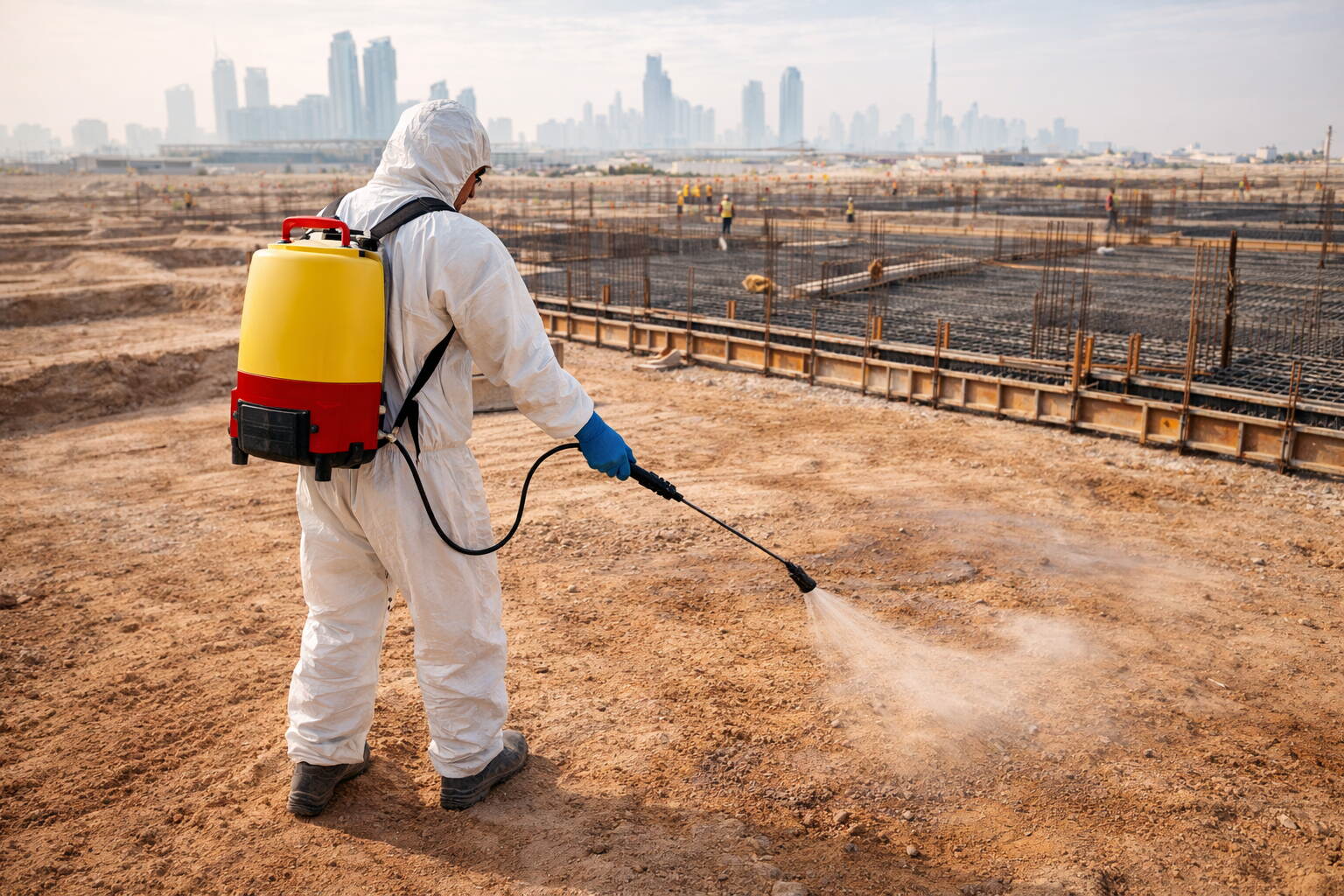
A DM-licensed technician applying termiticide to bare soil after excavation reaches final depth. This application must be complete and cured before any blinding concrete or formwork is placed on the treated surface.
Contractors are usually caught out at handover rather than at treatment stage — the work was done, but the documentation was never issued in the accepted format. See what a compliant DM-approved anti-termite certificate must contain before you sign off a project.
The 6-Stage Pre-Construction Anti-Termite Process
Pre-construction anti-termite treatment is not a single application event. It is a sequenced programme tied to specific construction milestones. Each stage must be completed in the correct order and at the correct build phase to create full sub-structure protection. The following six stages cover the complete process — from initial soil survey to post-handover maintenance.
Stages 1–3: From Soil Survey to Slab
1
Pre-Excavation Soil Survey
A DM-licensed technician surveys the plot before excavation begins. The survey assesses soil type (sandy vs. loam), existing termite activity in the surrounding area, and proximity to irrigation channels, landscaping beds, or adjacent buildings with known termite pressure. This data directly shapes the treatment plan — in particular the application rate per square metre. Dubai's sandy, fast-draining soil consistently requires higher termiticide volumes than standard international guidelines, and the survey quantifies that adjustment for each specific site.
Milestone trigger: Before excavation commences.
2
Termiticide Soil Treatment — Pre-Slab Application
After excavation reaches final design depth, the contractor applies DM-approved termiticide across the entire building footprint at the prescribed rate per square metre. This application must occur before any blinding concrete, rebar mesh, or formwork is placed on the treated surface. The chemical treatment creates a continuous horizontal barrier directly beneath the building's lowest structural element. This sub-slab barrier is the single most critical protective layer in the entire programme — once covered by concrete, it cannot be replaced or supplemented.
Critical rule: Allow a minimum curing period of four hours before blinding concrete is poured. Confirm this timing directly with your contractor before scheduling the concrete programme.
3
Service Penetration Treatment
All service penetrations passing through the treated soil zone — water supply pipes, drainage lines, electrical conduits, telecom ducts, and gas lines — represent potential gaps in the chemical barrier. Each penetration must be individually treated with termiticide before the surrounding soil is backfilled or the slab is poured over it. Subterranean termites are highly effective at locating and exploiting even small untreated gaps around pipe sleeves. Therefore, no penetration should be exempt — regardless of pipe diameter or service type.
Milestone trigger: After all below-slab pipe-laying is complete, before slab pour commences.
Stages 4–6: From Foundation to Handover
4
Foundation Perimeter Treatment
As foundation walls and column pads are formed and stripped, the external perimeter soil is treated with termiticide at each formwork stripping stage. This creates a vertical chemical barrier along all soil-to-structure interfaces around the building footprint. Additionally, expansion joints in the slab — which cannot be permanently sealed against termite ingress — receive supplementary treatment to compensate for the inherent entry risk they represent. Perimeter treatment must be applied in phases as formwork is stripped, not as a single end-of-foundation application.
Milestone trigger: At each stage of foundation formwork stripping.
5
DM Inspection and Completion Certificate
Once all soil treatment stages are complete, the DM-licensed contractor submits treatment documentation for inspection. This submission includes product data sheets, application records, site plans showing treated areas, and a copy of the contractor's current DM licence. The DM inspector verifies coverage completeness, confirms the product is from the approved list, and reviews the treatment log for all stages. Following a satisfactory inspection, the contractor issues the anti-termite completion certificate. This document must be retained by the developer as a permanent building record and submitted as part of the building permit closure package.
Milestone trigger: After all soil treatment stages are complete, before building permit closure submission.
6
Post-Handover Annual Maintenance Agreement
Termiticide residual activity in Dubai's sandy soil has a practical working life of seven to ten years. However, the chemical barrier can be locally breached by utility works, landscaping excavation, or soil settlement at any point during that period. Annual inspections allow early detection of any breach before termites can exploit it. Consequently, developers should establish an annual anti-termite maintenance contract before building handover to the owner or FM team. This ensures both structural protection continuity and compliance with Dubai Municipality's ongoing pest control requirements for occupied buildings.
Milestone trigger: Before Occupancy Certificate issuance and building handover.
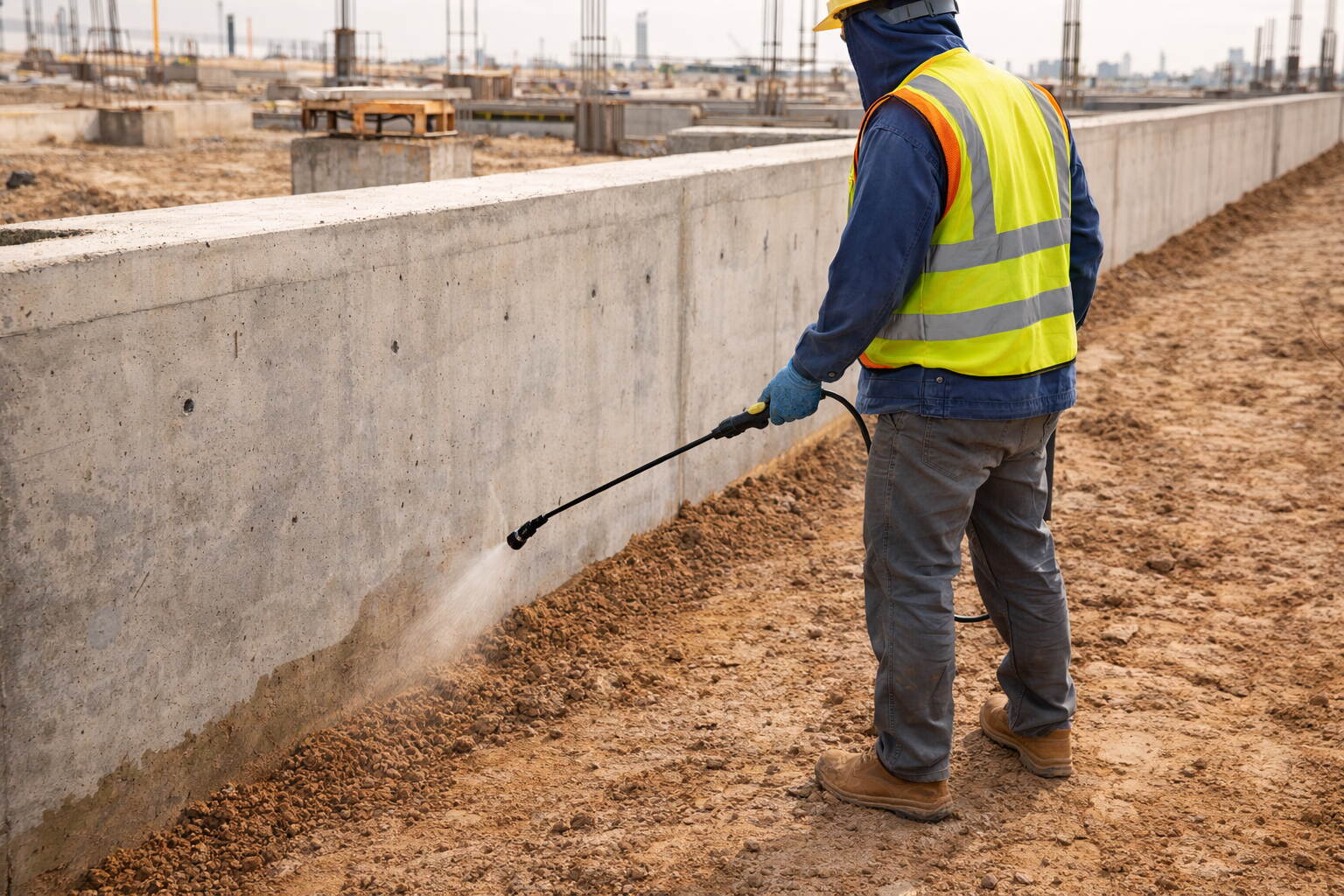
Foundation perimeter treatment at the soil-to-structure interface. This stage runs alongside formwork stripping and creates the vertical chemical barrier that complements the sub-slab horizontal treatment.
✅ Pre-Construction Anti-Termite Checklist: 10 Steps for Dubai Developers
Confirm your contractor holds a current Dubai Municipality pest control licence that specifically covers anti-termite soil treatment.
Request the DM-approved termiticide product data sheet and DM approval certificate number before any work begins.
Schedule the pre-excavation soil survey before excavation reaches final design depth.
Apply soil treatment only after excavation reaches final depth — never on partially excavated or interim-level ground.
Do not pour blinding concrete or place formwork until the termiticide has cured for a minimum of four hours.
Treat all service penetrations individually before backfilling — no pipe, conduit, or duct is exempt.
Apply perimeter treatment at each stage of foundation formwork stripping, not as a single final application at the end.
Retain all application records, product data sheets, site treatment plans, and on-site treatment logs.
Book the DM inspection and obtain the completion certificate before submitting the building permit closure package.
Establish an annual anti-termite maintenance contract before the Occupancy Certificate is issued to the building owner or FM team.
Ready to plan your pre-construction anti-termite programme? Supernova's DM-licensed team covers all six treatment stages — with full documentation and a completion certificate included as standard.
How to Choose a DM-Licensed Anti-Termite Contractor in Dubai
Not every pest control company in Dubai holds the correct licence for pre-construction anti-termite soil treatment. Furthermore, technical quality varies significantly between contractors — even among those who are licensed. These four criteria identify contractors capable of delivering a valid, complete, and well-documented programme that will pass DM inspection on the first attempt.
🏛️
Current DM Anti-Termite Licence
Verify the contractor's Dubai Municipality pest control licence is current and specifically covers anti-termite soil treatment. Request the licence number and confirm it directly with DM's Public Health department before appointment. A lapsed or scope-limited licence invalidates the completion certificate — and the building permit cannot be closed without it.
🧪
DM-Approved Product Only
Confirm the contractor uses a termiticide currently on Dubai Municipality's approved pesticides list. Request the product data sheet, the DM approval certificate number, and the proposed application rate per m² in writing before work begins. Reject any contractor who cannot provide these documents upfront — this is a fundamental indicator of programme quality.
📋
Full Documentation Package
A professional contractor provides a site-specific treatment plan, a pre-treatment soil survey report, an on-site treatment log completed at each stage, and the anti-termite completion certificate following DM inspection. This documentation package is precisely what the DM inspector reviews — and what the developer must retain for the building's permanent record and any future maintenance contracts.
⏱️
Construction Programme Coordination
Pre-construction treatment must synchronise precisely with the concrete pour schedule. Choose a company experienced in construction site coordination — one that can mobilise on short notice when excavation reaches final depth, and that understands the critical timing constraints of a live construction programme. Poor coordination is the single most common reason treatment windows are missed on Dubai sites.
A DM-licensed inspector reviewing anti-termite treatment documentation. The completion certificate issued after this review is required for building permit closure in Dubai.
Supernova's pre-construction anti-termite programme covers all six treatment stages for commercial and residential developments across Dubai. We provide a complete site survey, stage-by-stage treatment, DM inspection support, and completion certificate — coordinated directly with your construction programme so the treatment window is never missed. For facilities management teams receiving newly completed buildings, we also structure post-handover annual maintenance contracts that maintain the chemical barrier warranty from day one of occupation. Contact us on 056 511 5970 or WhatsApp to discuss your project timeline.
Frequently Asked Questions
Is pre-construction anti-termite treatment mandatory in Dubai?
Yes. Dubai Municipality requires anti-termite soil treatment as part of the building permit process for new constructions and ground-floor fit-outs. The treatment must be completed before the concrete slab is poured and verified by a DM inspection. Without a valid anti-termite completion certificate, Dubai Municipality, Trakhees, and DDA will not issue final building approvals or the Occupancy Certificate. Under Dubai Local Order No. 11 of 2003, the main contractor is legally responsible for ensuring treatment is completed correctly and on schedule.
What chemicals does Dubai Municipality approve for pre-construction soil treatment?
Dubai Municipality maintains an approved pesticides list for anti-termite soil treatment, which is reviewed and updated periodically. Approved formulations currently include synthetic pyrethroid-based and phenylpyrazole-based termiticides applied at DM-prescribed rates per square metre. Products removed from previous versions of the approved list are no longer valid regardless of historical use. Always request the DM approval certificate number from your contractor before treatment begins, and verify the product's current status directly with DM's Public Health department to avoid a failed inspection.
How long does pre-construction anti-termite treatment last?
In Dubai's sandy soil conditions, DM-approved termiticide formulations have a practical residual activity of seven to ten years. However, the chemical barrier can be locally compromised by utility works, landscaping excavation, or soil movement at any point. Annual inspections are required to maintain the treatment warranty and to identify any breach early. Consequently, developers should establish an annual anti-termite maintenance contract before handover to ensure uninterrupted protection throughout the building's operational life.
What happens if the concrete slab is poured before treatment is applied?
If the slab is poured before pre-construction anti-termite soil treatment is applied, the sub-slab soil is permanently inaccessible — and the horizontal chemical barrier cannot be installed at any later stage. Post-construction remedial treatment can only address the building perimeter and cannot replicate the sub-slab protection. Additionally, without the pre-slab treatment stage having been completed correctly, the DM completion certificate cannot be issued. This means the building permit cannot be closed and the Occupancy Certificate cannot be obtained until a remedial programme is agreed with Dubai Municipality.
Can anti-termite treatment be applied after construction is complete?
Post-construction anti-termite treatment is possible but significantly less effective than pre-construction soil treatment. After construction, treatment is limited to the building perimeter, expansion joints, and service penetrations — the sub-slab soil cannot be reached. Post-construction treatment is used for existing buildings showing signs of termite activity or for buildings where pre-construction treatment was missed. For new builds in Dubai, post-construction treatment does not satisfy the DM requirement for a pre-slab completion certificate. Contact Supernova's anti-termite team to assess the best remedial approach for your specific situation.
How much does pre-construction anti-termite treatment cost in Dubai?
Pre-construction anti-termite treatment in Dubai is priced per square metre of treated area, with adjustments for soil type, building complexity, and the number of service penetrations. Sandy soil sites typically require higher product volumes — which affects cost versus clay-dominant sites. The full programme includes the soil survey, multi-stage application, on-site treatment logging, and the DM completion certificate. WhatsApp Supernova on 056 511 5970 with your building footprint area and construction programme for a fixed-price quote tailored to your project.
Does the DM anti-termite completion certificate expire?
The anti-termite completion certificate itself does not carry a fixed expiry date — it records a specific treatment event and is a permanent building record. However, the chemical barrier the certificate represents does have a practical lifespan of seven to ten years in Dubai's soil conditions. After this period, the barrier may no longer provide adequate protection. Annual inspections under a maintenance contract are the standard mechanism for monitoring barrier integrity and ensuring ongoing compliance with Dubai Municipality's pest control requirements for occupied buildings.
What is the difference between subterranean and drywood termite treatment at construction stage?
Pre-construction soil treatment specifically targets subterranean termites — the primary structural threat in Dubai — which enter buildings from soil contact points below the foundation. Drywood termites, by contrast, infest timber directly and do not require soil contact. At the construction stage, subterranean termite risk is addressed by the soil treatment programme described in this guide. Drywood termite risk is managed by treating structural and joinery timber during the fit-out phase. Both risks are present in Dubai, but subterranean termites represent the greater structural threat and are the focus of DM's mandatory pre-construction treatment requirement.
🦟
Supernova Technical Team
Supernova Pest Control is a Dubai Municipality licensed pest control company serving developers, contractors, FM companies, and building owners across all Dubai communities. Our pre-construction anti-termite programmes are coordinated with live construction schedules to ensure treatment windows are never missed. Learn more at supernovaemirates.com.