Signs of termite damage in commercial buildings UAE include mud tubes, frass, hollow timber, and stuck door frames.
Two species affect UAE buildings — subterranean and drywood — and each requires a different treatment approach.
Commercial buildings have six high-risk zones that standard residential inspections routinely miss.
A mature termite colony can cause significant structural damage within 3–6 months in Dubai's climate.
Thermal imaging inspection identifies active colonies behind walls and ceilings without destructive access.
The signs of termite damage in commercial buildings across the UAE are rarely obvious until the infestation is already advanced. Unlike residential properties, office buildings, retail centres, and warehouses present complex environments — suspended ceilings, raised floors, timber partitions, and extensive service voids — that allow termite colonies to grow undetected for months. Furthermore, FM managers face a particular challenge: the building fabric they are responsible for is often unseen behind finishes, making routine visual checks insufficient. This guide explains exactly what to look for, where to look, and when to act.
Why Commercial Buildings in Dubai Face Higher Termite Risk
Dubai's built environment creates near-ideal conditions for termite activity. However, commercial properties face a distinct set of risk factors that residential buildings do not share in the same way. Understanding these factors helps FM managers prioritise inspection frequency and coverage.
Dubai's Climate and Soil Conditions
The UAE's combination of warm sandy soil, irrigation systems near building perimeters, and consistent high temperatures creates a year-round feeding environment for subterranean termites. Additionally, the region's sandy loam soil allows subterranean colonies to extend their foraging tunnels rapidly over large distances. As a result, a colony nesting beneath a landscaped strip along a building's perimeter can extend foraging activity 50 metres or more into the structure above.
Moreover, the irrigation networks that serve commercial landscape areas run along foundation walls. These systems keep the soil consistently moist — exactly the conditions subterranean termites prefer for building their mud tunnel networks upward into the building fabric.
How Quickly Termite Colonies Grow in the UAE
In Dubai's climate, termite breeding cycles operate at a significantly faster rate than in temperate regions. A mature subterranean colony contains between 60,000 and 1,000,000 workers. Furthermore, a colony at full strength consumes approximately 2.3kg of wood per week. Consequently, a commercial property with untreated timber door frames, ceiling battens, or wooden partition systems faces significant structural and cosmetic damage within a single season.
The critical timeframe is three to six months. Within this period, a mature colony can compromise timber elements that are not replaced cheaply — roof battens, structural lintels over door openings, and sub-floor joinery. Therefore, early detection and swift treatment are essential.
Why Office Buildings Are Harder to Inspect Than Homes
Residential properties have limited hiding places for termite activity. However, commercial buildings present multiple inaccessible zones: suspended ceiling voids running the length of entire floors, raised access floors in IT rooms and trading floors, timber partition systems built floor-to-ceiling, and service ducts carrying cables and pipework through every storey.
Additionally, commercial properties often undergo periodic fit-out changes — tenant departures, office reconfigurations, partition additions — that disturb existing building fabric and create new access points for termites. Similarly, the high volume of foot traffic in occupied office buildings means that subtle warning signs like small frass accumulations or faint clicking sounds in walls are easily missed by occupants and cleaning teams.
Two Termite Species — and How Their Damage Differs
Identifying the correct termite species in your building is not simply an academic exercise. It fundamentally changes both the treatment approach and the urgency of remediation. Furthermore, the warning signs each species leaves are distinctly different. Sending the wrong evidence photograph to a pest control company can delay diagnosis and allow the infestation to expand.
Subterranean Termites — Foundations, Mud Tubes, and Fast Structural Damage
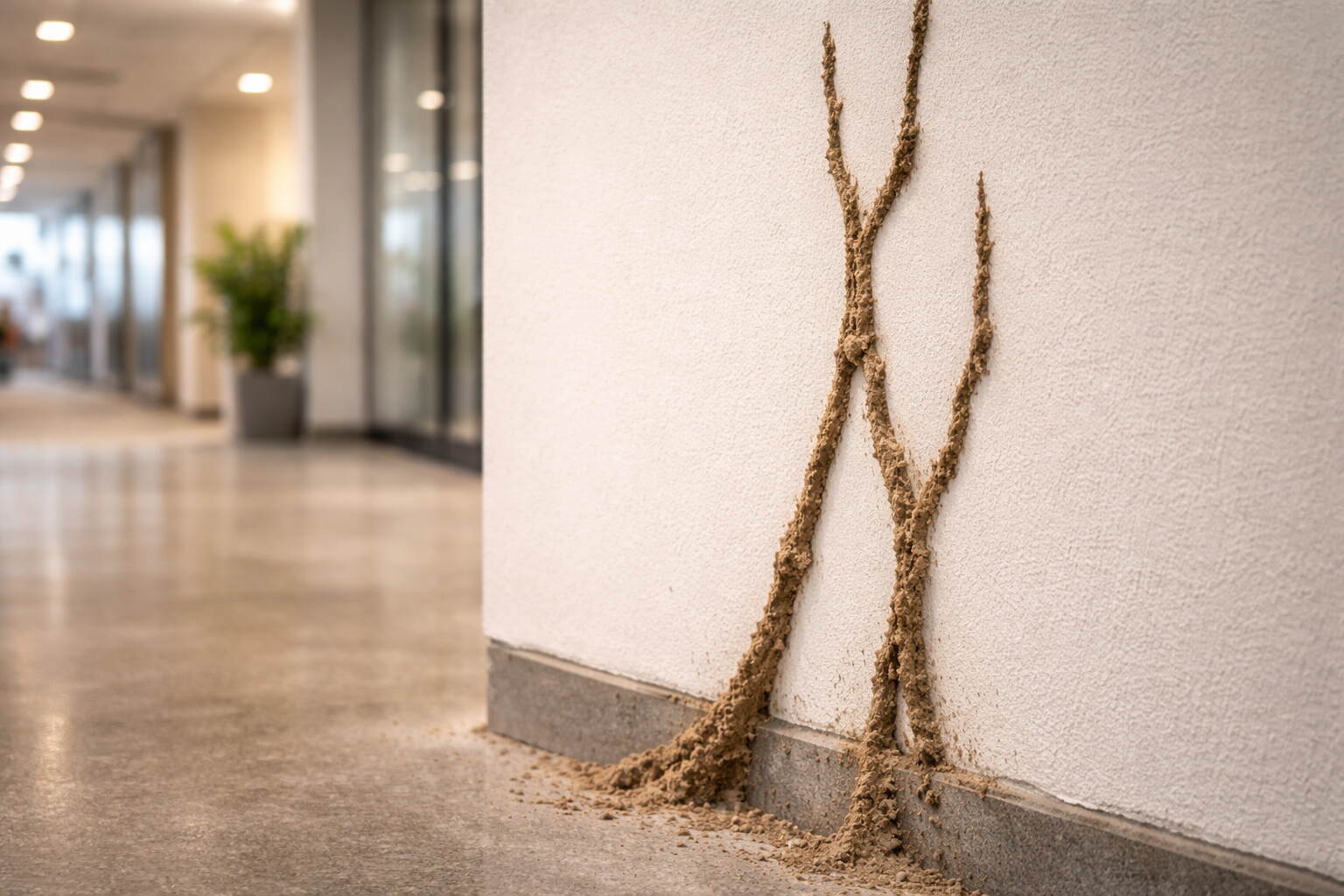
Subterranean termites are the most destructive species in the UAE. Their colonies nest underground and travel upward through the soil. To move through exposed surfaces above ground level, they construct mud tubes — pencil-width channels made of soil, saliva, and excrement — along foundation walls, column bases, and pipe chases. These tubes are the most reliable visible indicator of subterranean termite activity.
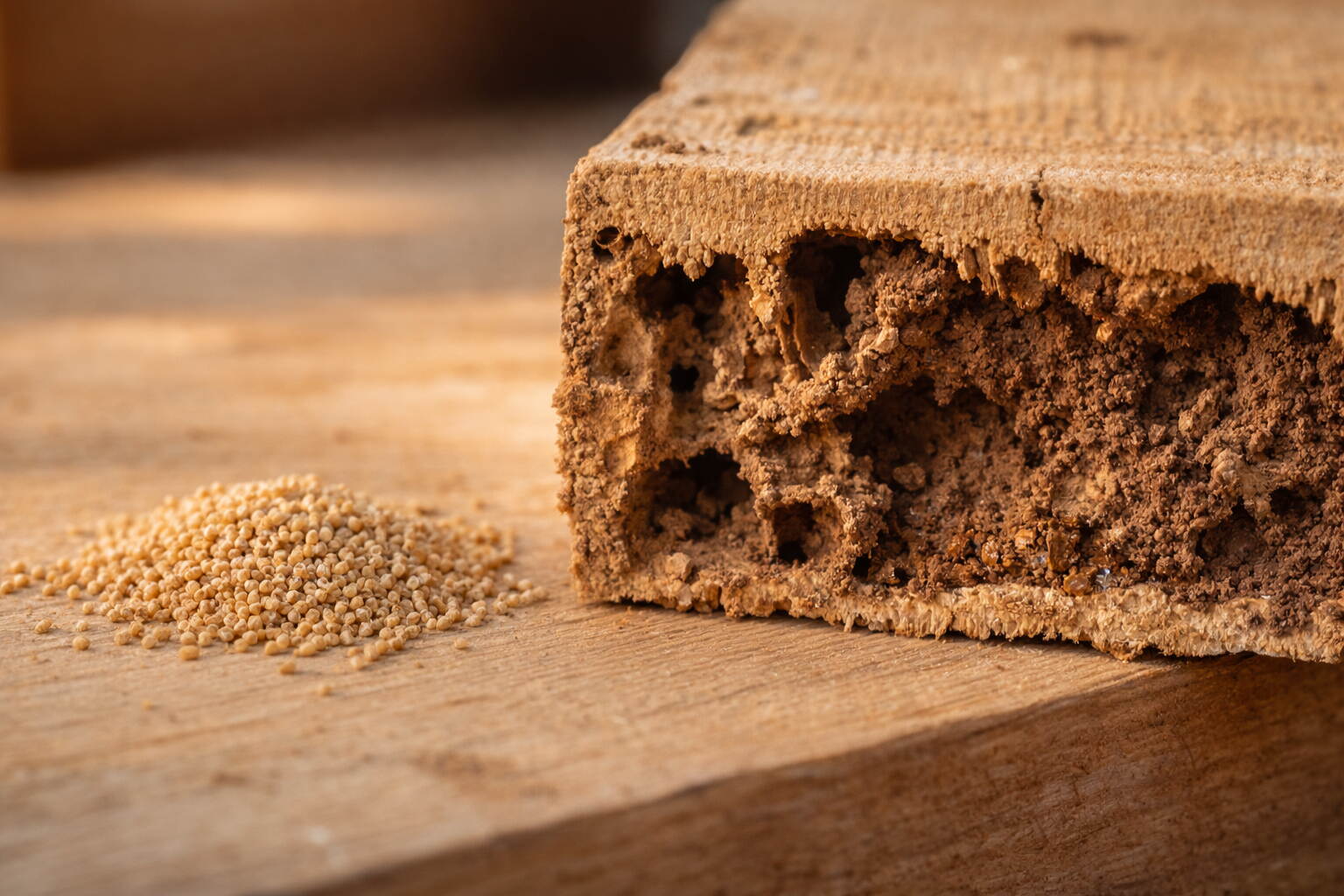
Inside the building, subterranean termites consume wood along the grain, packing their feeding galleries with damp soil and mud. Consequently, timber attacked by subterranean termites retains a thin shell of intact wood or paint on the surface, while the internal structure is almost completely consumed. Probing the timber with a screwdriver causes the surface to collapse inward. Furthermore, the affected timber will feel slightly damp to the touch due to moisture from the colony's soil-packing behaviour.
Subterranean infestations spread horizontally and vertically simultaneously. As a result, by the time a mud tube is visible on an interior wall, the colony may already be feeding on multiple floors above and below the visible evidence.
Drywood Termites — Hidden Galleries and Frass Pellets in Timber Fittings
Drywood termites behave very differently. They nest inside the timber they infest — requiring no soil contact whatsoever. Additionally, their colonies are smaller, typically numbering fewer than 5,000 workers. Consequently, drywood termite damage progresses more slowly than subterranean damage — but it is no less destructive over time and is significantly harder to detect.
The primary visible sign of drywood termite activity is frass — tiny, hard, hexagonal pellets that the colony ejects through small kick-out holes in the timber surface. These pellets look like fine sawdust or coffee grounds and accumulate in small piles below the infested timber element. In commercial buildings, frass is most commonly found beneath timber skirting boards, below wooden door frames, under furniture and joinery built from solid timber, and on horizontal ledges near ceiling battens.
Moreover, tapping infested timber produces a distinctly hollow sound. The wood surface often remains intact — drywood termites do not use mud packing — making visual detection without probing extremely difficult.
Why the Species Matters Before Calling a Specialist
The two species require entirely different treatment strategies. Subterranean infestations are treated through soil barrier chemicals, baiting systems, and structural injection at entry points. Drywood infestations are treated through localised fumigation, heat treatment of affected elements, or whole-building structural fumigation for severe cases.
Therefore, if you photograph mud tubes, you have a subterranean infestation — and the most urgent priority is preventing further spread through the building's service voids. If you collect frass pellets, you have a drywood infestation — and the priority is locating all infested timber elements before treatment to ensure complete coverage.
⚠️ FM Alert — The 3-to-6-Month Window
According to Dubai Municipality's Public Health Pest Control guidelines, all commercial property owners are responsible for maintaining pest-free premises. A mature subterranean termite colony in Dubai's climate can cause significant structural damage within 3 to 6 months of establishing activity in a building. If you have spotted a warning sign — even a single mud tube — the correct action is to commission a professional inspection within one week, not to monitor and wait.
Left: drywood termite frass pellets ejected from kick-out holes. Right: subterranean termite damage showing mud-packed internal galleries. Each species requires a different treatment protocol.
Six High-Risk Zones to Inspect in Your Commercial Building
Most generic termite guides focus on residential inspection areas — roof spaces, skirting boards, and garden timber. However, commercial buildings have six distinct high-risk zones that residential inspection checklists routinely miss. FM managers who understand these zones can conduct a preliminary walk-through that either confirms no visible activity or builds an evidence pack to share with a specialist before the inspection visit.
Zones 1–3: Ground-Level and Sub-Structure Risk Areas
1
Exterior Perimeter Walls, Column Bases, and Foundation Level
This is where subterranean termite activity almost always begins and where mud tubes are most likely to appear first. Walk the full perimeter of the building at ground level and examine the base of all external walls, column bases, expansion joint covers, and drain surround areas. Additionally, check any point where soil level is elevated above the DPC (damp-proof course) line — landscape beds planted against the building perimeter are a very common entry point. Look for: mud tubes (even partially built and apparently inactive), soil disturbance in consistent patterns along wall bases, and paint or render blistering at low level.
FM Note: Inspect immediately after any landscaping work or irrigation system maintenance — soil disturbance accelerates termite exploration activity near entry points.
2
Ground-Floor Skirting Boards, Timber Door Frames, and Partition Bases
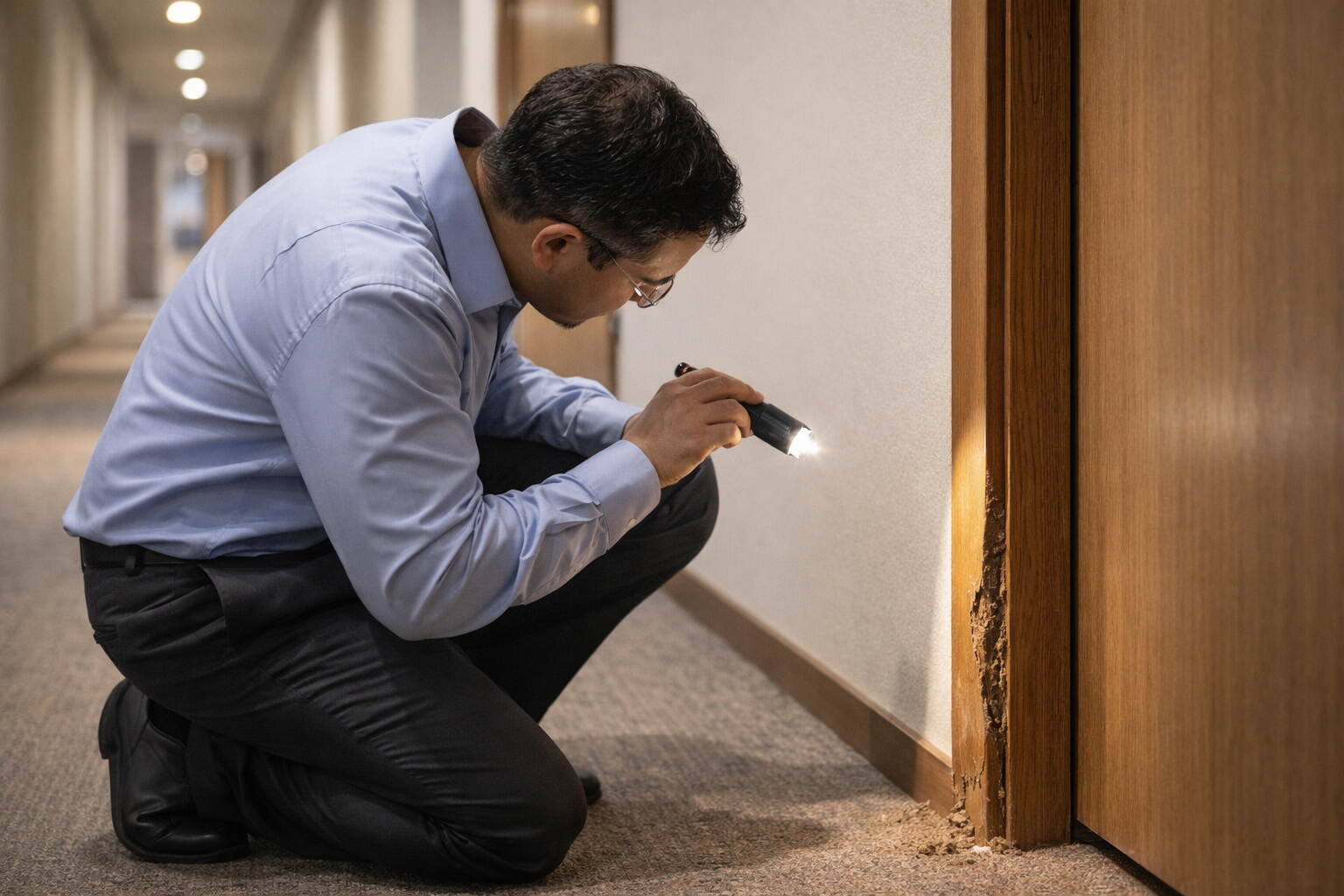
Timber skirting boards, MDF architraves around door frames, and the base rails of timber partition systems are the first internal building elements that subterranean termites reach after ascending from the foundation. Similarly, drywood termites that entered through infested imported furniture or joinery often establish secondary colonies in these elements. Tap all timber elements at ground-floor level with a screwdriver handle — a hollow return rather than a solid thud indicates internal damage. Furthermore, press lightly along the bottom edge of skirting boards; if they flex or crumble, internal feeding is already advanced.
FM Note: Focus particularly on any door frames adjacent to external walls and any skirting boards at the base of walls that adjoin plant rooms or service shafts — these are common entry corridors.
3
Raised Access Floors, Sub-Floor Voids, and IT Room Plinths
Raised access floor systems — common in trading floors, server rooms, and open-plan offices — create an enclosed void between the structural slab and the floor surface. This void is warm, dark, and often maintains slightly elevated humidity from condensation around chilled water pipework and AC supply ducts running beneath the floor. Consequently, it represents an almost ideal microhabitat for subterranean termites ascending from below-slab soil. Additionally, wooden support pedestals and cross-bearers beneath some raised floor systems provide direct food sources. Remove and check access floor tiles near external walls and at corners — the perimeter zone is the highest-risk area.
FM Note: Frass deposits beneath raised floor tiles that appear near cable bundles or around pedestal bases are often mistaken for construction dust — collect samples and compare to the frass photograph in this article.
Zones 4–6: Upper-Level and Specialist Risk Areas
4
Suspended Ceiling Voids and Ceiling Battens
In commercial buildings, suspended ceilings create a continuous horizontal void that runs across entire floor plates. This void is typically inaccessible to routine visual inspection — and that inaccessibility is precisely what makes it high-risk. If timber ceiling battens, wooden conduit supports, or MDF ceiling panels are present in the void, they provide a food source that can sustain a substantial colony. Moreover, once termites establish feeding activity in a ceiling void, they can distribute laterally across an entire floor before any ground-level evidence becomes visible. Therefore, randomly remove 2–3 ceiling tiles per quadrant during any routine maintenance visit and use a torch to inspect visible battens and surrounding surfaces for mud tubes or frass.
FM Note: Clicking or rustling sounds coming from ceiling voids — particularly noticeable in quiet early-morning periods — are a reliable indicator of active termite soldier activity. Report any such sounds immediately.
5
Server Rooms, Electrical Riser Ducts, and AC Drainage Points
This zone is unique to commercial buildings and is entirely absent from residential inspection frameworks. Server rooms and telecommunications rooms maintain continuous cooling — which generates condensation on cold surfaces and cold pipe runs. This condensation creates consistent localised moisture in areas that are otherwise dry, drawing subterranean termite activity specifically toward these rooms. Additionally, electrical cable trays and riser ducts provide physical pathways for termites to travel vertically between floors without any visible external evidence. Furthermore, the consistent warmth of active server rooms accelerates termite metabolism — colonies in proximity to server rooms are often more active than colonies elsewhere in the same building.
FM Note: Inspect the base of all electrical risers, the perimeter walls of server rooms, and the underside of any cable trays adjacent to external walls. Even small mud tube traces on cable conduit surfaces are significant.
6
Landscape Perimeter, Irrigation Junction Points, and External Timber
The building's external landscape zone is where most commercial termite infestations originate — yet it is rarely included in internal FM inspection programmes. Subterranean termite colonies nest in the moist soil beneath irrigated landscape beds and use the consistent moisture to build their foraging tunnel network toward the building. Moreover, external timber elements — pergola posts, wooden screen panels, landscape decking, and timber planter surrounds — provide food sources close enough to the building structure to serve as stepping stones for colony expansion. Additionally, tree stumps or large root systems within 10 metres of the building perimeter represent established nesting habitats that should be treated proactively.
FM Note: Check all irrigation emitter locations that are within one metre of the building perimeter. Where emitters have been placed directly against a wall, ensure soil is graded away from the foundation and that no moisture accumulation is present at wall base.
A systematic zone-by-zone inspection of timber door frames and skirting boards at ground level takes under 30 minutes per floor and can catch subterranean activity before it reaches ceiling voids.
✅ Quick Termite Warning Signs Checklist: 10 Things FM Managers Must Check in UAE Commercial Buildings
Mud tubes (pencil-width channels of compacted brown soil) on external walls, column bases, or skirting board backs — confirms subterranean termite activity.
Hollow sound when tapping timber skirting boards, door frames, or partition panels with a screwdriver handle — internal feeding already in progress.
Small piles of tiny hexagonal pellets (frass) on floors, ledges, or furniture surfaces beneath timber elements — confirms drywood termite activity.
Paint or plaster blistering at low level on internal walls, particularly near corners and door frames — subterranean termites raising moisture through the wall.
Doors or windows that have recently become difficult to open or close — timber frames swelling or distorting under subterranean termite moisture and feeding.
Discarded wings (translucent, equal-length pairs) near light fittings, windowsills, or external entry doors — evidence of a recent swarm event indicating a nearby established colony.
Visible kick-out holes (pinhead-sized circular openings) in the surface of wooden furniture, joinery, or wall panels — drywood termite exit points for frass ejection.
Clicking or rustling sounds from ceiling voids or wall cavities during quiet periods — soldier termites tapping warning signals within an active colony.
Soil disturbance or small mounds at the base of landscape beds directly adjacent to the building perimeter — subterranean colony foraging near the structure.
Frass or fine debris accumulation beneath raised access floor tiles near external walls or IT room corners — subterranean or drywood activity in the sub-floor void.
Spotted Any of These Signs?
Supernova's DM-licensed termite specialists provide free commercial building inspections — including thermal imaging — across Dubai. Don't monitor and wait.
When to Call a Specialist — and What to Expect from the Inspection
Visual evidence of any one warning sign on the checklist above warrants a professional inspection within seven days — not a scheduled quarterly visit. However, the quality of the inspection matters as much as its timing. Many commercial FM managers have experienced inspections that resulted in a verbal report and no actionable documentation. Therefore, knowing what a properly conducted commercial termite inspection should include helps you select the right provider and set the right expectations.
🏛️
Valid Dubai Municipality Pest Control Licence
Only a DM-licensed pest control company can legally carry out termite treatments in Dubai. Before booking any inspection, verify the provider's licence number through the DM Public Health Pest Control Section. An unlicensed operator cannot issue a valid treatment certificate, which creates a compliance gap in your FM records.
🔬
Thermal Imaging and Moisture Meter Survey
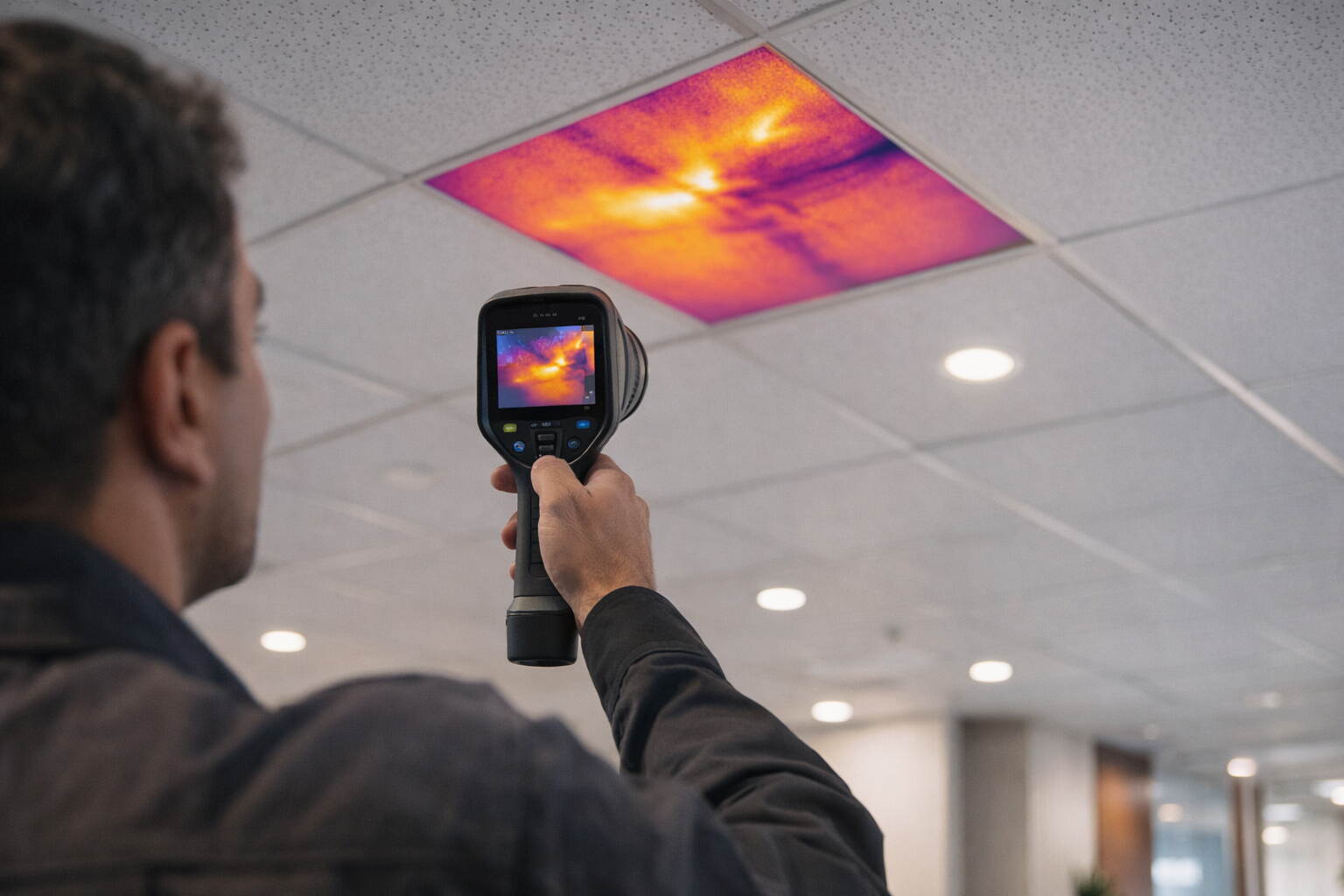
A professional commercial termite inspection should include thermal imaging cameras and moisture meters — not just a visual walk-through. Thermal imaging detects the heat signature and moisture differential of active colonies behind plasterboard, above suspended ceilings, and within structural walls without destructive access. Consequently, it locates infestations that a torch-and-probe inspection would miss entirely.
📋
Written Report with Floor-Plan Marking
The inspection report must identify active zones and risk areas on a floor-plan or building diagram — not just a written list. Additionally, the report should specify the species identified, the treatment method recommended, and the expected treatment timeline. This document forms part of your FM compliance record and should be filed in the building's health and safety register.
🛡️
Post-Treatment Warranty and Follow-Up
Any commercial termite treatment should be accompanied by a written warranty covering a minimum of 12 months. Furthermore, the provider should schedule at least one follow-up inspection at 30 and 90 days post-treatment to confirm that the treatment is performing as expected and that no new activity has been detected in adjacent areas.
Thermal imaging during a commercial termite inspection locates active colonies and moisture sources inside walls and ceiling voids — without any destructive access.
Supernova's anti-termite treatment service in Dubai covers both subterranean and drywood infestations in commercial buildings — with thermal imaging surveys, written floor-plan reports, and a 12-month post-treatment warranty as standard. For buildings requiring an ongoing annual programme, our annual pest control contract includes scheduled termite inspections alongside full pest management coverage. Additionally, our FM pest control service is designed specifically for commercial property managers requiring regular documentation, compliance records, and rapid response SLAs.
For managed portfolios, the inspection report is not the document your client files — building management and Municipality both want the compliance certificate. Here is what an anti-termite certificate for a Dubai commercial property covers.
Frequently Asked Questions — Termite Damage in Commercial Buildings UAE
What are the first signs of termite damage in a commercial building in Dubai?
The earliest and most reliable signs are mud tubes on exterior foundation walls and column bases, and frass accumulations beneath timber skirting boards or door frames. Additionally, a hollow return when tapping timber with a screwdriver handle is an early indicator of internal feeding. Furthermore, paint blistering at low level on interior walls near corners and door frames often appears before any timber surface deformation becomes visible. Any of these signs warrant a professional inspection within the week — not at the next scheduled quarterly visit.
How do I tell the difference between subterranean and drywood termite damage in my office building?
Subterranean termites always leave mud tubes — pencil-width channels of compacted brown soil on wall surfaces, pipe chases, or column bases. Their damage galleries inside timber are packed with damp mud. In contrast, drywood termites leave no mud tubes and no soil. Instead, they push tiny hexagonal pellets called frass through small kick-out holes in the timber surface. These pellets look like fine sawdust or coffee grounds. Collecting samples of each type and photographing both the frass and any kick-out holes before calling a specialist will significantly speed up the diagnosis process.
Can termites travel between floors in a commercial building?
Yes — subterranean termites routinely travel between floors through electrical riser ducts, pipe chases, and service shafts. These enclosed vertical routes allow colonies to reach upper floors without any visible surface evidence on intermediate levels. Additionally, once inside a suspended ceiling void, termites can spread horizontally across an entire floor plate before descending through partition frames or timber elements to the floor below. This is why a ground-floor mud tube discovery should trigger an inspection of all floors above — not just the affected area. Supernova's commercial anti-termite service includes a building-wide survey rather than a floor-specific assessment.
How often should a commercial building in Dubai have a professional termite inspection?
Dubai Municipality recommends annual professional pest inspections for commercial properties. However, for high-risk buildings — those with landscaped perimeters with irrigation, timber partition systems, or raised access floors — a six-monthly inspection is more appropriate. Additionally, any building that has had a previous termite infestation should maintain quarterly inspections for a minimum of two years after treatment, regardless of whether the warranty is still active. An annual pest control contract with Supernova includes scheduled termite inspections as part of the programme.
What happens if termites are found during an FM compliance inspection or building audit?
Finding an active termite infestation during a third-party audit or compliance inspection without any evidence of a management programme in place can have significant implications. It may constitute a breach of the property owner's obligations under Dubai Local Order No. 11 of 2003 on Public Health. Furthermore, it may trigger recommendations to vacate affected areas until treatment and structural assessment are completed. As a result, FM managers should maintain a pest control programme with full documentation at all times — not only to prevent infestation but to demonstrate due diligence during any audit.
Are server rooms and IT rooms particularly vulnerable to termites?
Yes — and this is one of the most underappreciated termite risks in commercial buildings. Server rooms generate condensation on cold pipe runs and air supply ducts, creating consistent moisture in areas that are otherwise dry. This localised moisture draws subterranean termites specifically toward server room zones. Additionally, the electrical cables, conduit bundles, and raised floor systems in these rooms provide protected travel routes. Termites in server room environments can damage cable insulation, create shorting risks, and compromise raised floor structural pedestals. Regular inspection of server room perimeter walls and raised floor sub-voids is essential.
What does a commercial termite treatment involve and how disruptive is it?
The treatment method depends on the species and severity of the infestation. Subterranean infestations are typically treated with soil injection, localised chemical barriers applied to entry points, and baiting systems that eliminate the colony over 4–8 weeks. Drywood infestations may be treated with localised foaming agents injected through small-diameter holes or heat treatment of affected elements. For most commercial buildings, treatment can be carried out during out-of-hours periods with minimal business disruption. However, severely advanced infestations may require temporary clearance of affected areas for structural foaming. Supernova's commercial pest control team works around building occupancy schedules as standard.
How quickly can Supernova respond to a suspected termite infestation in a commercial building?
Supernova offers same-day or next-day emergency inspection appointments for commercial properties with suspected active termite infestations. The initial inspection includes a visual survey of all reported areas, thermal imaging of suspected zones, and a written report with photographic evidence within 24 hours of the inspection visit. Contact Supernova directly via WhatsApp at 056 511 5970 for priority booking. For FM companies requiring contracted response SLAs, our facilities management pest control programme includes guaranteed response times written into the service agreement.
🪲
Supernova Technical Team
Supernova Pest Control is a Dubai Municipality licensed pest control company specialising in commercial termite inspections, anti-termite treatments, and FM pest management programmes across Dubai. Our team uses thermal imaging technology for non-invasive building surveys and provides full written documentation for FM compliance records. View all pest control services →