Supernova

Pest Control, Cleaning & Water Tank Services in Dubai

Supernova

Pest Control, Cleaning & Water Tank Services in Dubai

Supernova

Pest Control, Cleaning & Water Tank Services in Dubai

Termite Control · Villa Owners

How to Tell if Your Dubai Villa Has Termites (Early Warning Signs)

✍️ Supernova Technical Team | 🗓️ | ⏱️ 9 min read | 🏷️ Termite Signs · Dubai Villa · UAE Home
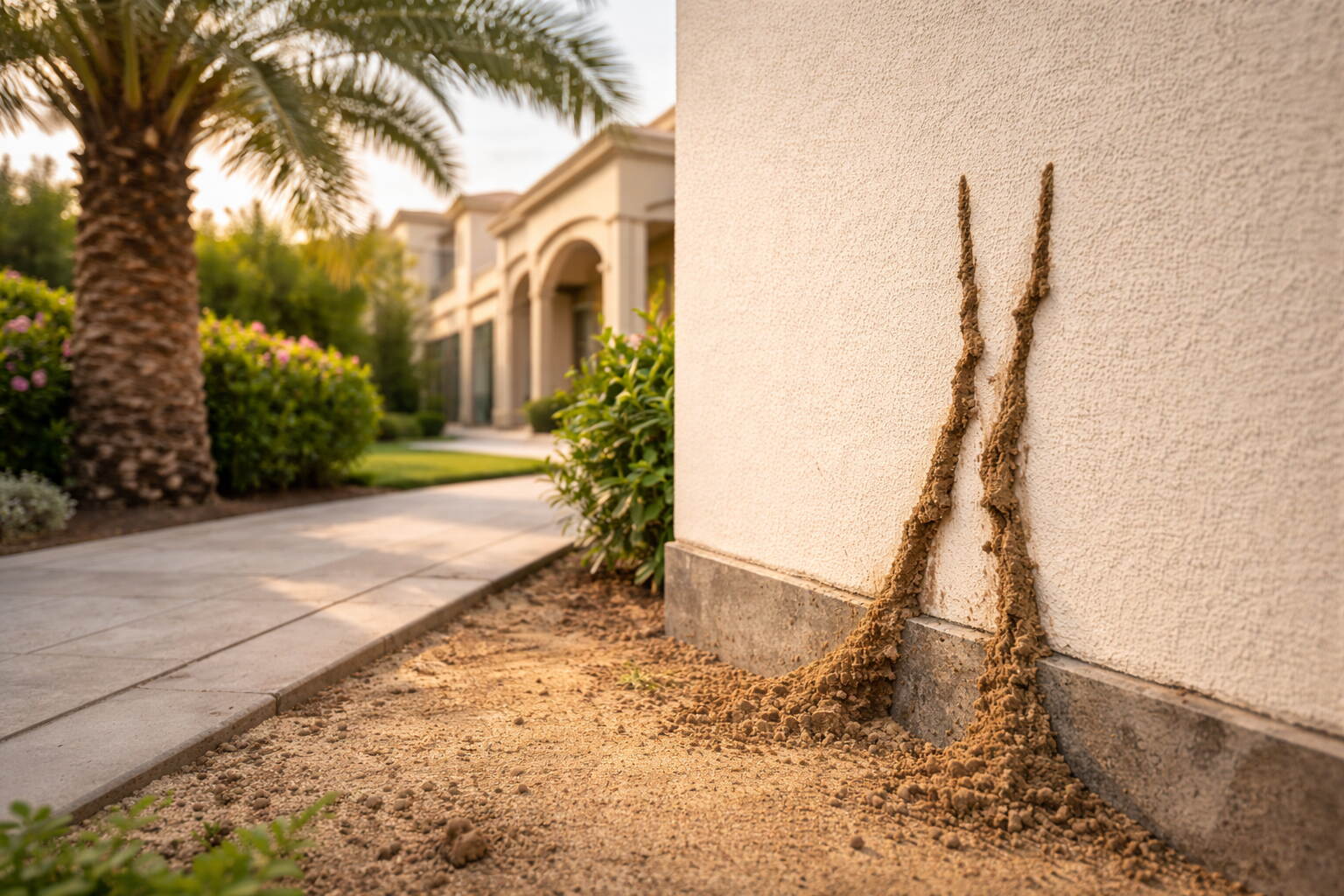
Termite signs Dubai villa — mud tubes visible at the base of a garden boundary wall in a Dubai villa compound

⚡ Key Takeaways

  • Termite signs in a Dubai villa include mud tubes, hollow-sounding wood, frass pellets, bubbling paint, and discarded wings.
  • Dubai's irrigated gardens and warm sandy soil make villa properties especially vulnerable to subterranean termite colonies.
  • A mature termite colony consumes up to 1kg of wood per day — parquet flooring, door frames, and built-in wardrobes are at highest risk.
  • Flying termites swarm after rainfall, typically in spring — finding wings indoors confirms an established colony nearby.
  • Do not spray or disturb suspected termite activity — photograph it and call a DM-licensed specialist within the week.

If you've noticed something suspicious in your home — a tiny pile of dust under a door frame, a faint hollow sound when you knock on a wall, or a cluster of wings on the windowsill — you may already be seeing termite signs in your Dubai villa. Termites are exceptionally common in Dubai's villa communities, and they are equally skilled at staying hidden. Furthermore, by the time damage becomes obvious, a colony has typically been active for months. This guide helps you identify exactly what to look for, where to check, and when to act.

Why Dubai Villas Are Particularly Vulnerable to Termites

Dubai villa owners face a higher-than-average termite risk compared to apartment residents or commercial tenants. Three specific factors combine to make freestanding villas the preferred target for subterranean termite colonies in the UAE.

The Garden and Irrigation Factor

Every Dubai villa garden is irrigated — and that irrigation system is quietly working in a termite colony's favour. Subterranean termites need consistently moist soil to build their underground tunnel networks. Without irrigation, Dubai's sandy, fast-draining soil dries out and prevents colony expansion. However, with daily irrigation running along your garden perimeter, the soil around your villa's foundation stays at ideal termite-foraging moisture levels year-round.

Additionally, landscaped garden beds planted directly against the villa boundary wall are an extremely common entry point. The combination of moist soil, organic mulch, and proximity to the building structure creates a near-perfect colony launch point. As a result, the garden is where most Dubai villa termite problems originate — not inside the house.

How Fast Termites Work in Dubai's Climate

In Dubai's climate, termite colonies grow and feed at a significantly faster rate than in cooler countries. A mature subterranean colony typically contains between 60,000 and 1,000,000 workers. Moreover, at full strength, a colony consumes approximately one kilogram of wood per day. Consequently, a villa's parquet flooring, built-in wardrobe panels, door frames, kitchen cabinetry, and staircase timber can all suffer substantial structural damage within a single season if an infestation goes undetected.

The critical warning period is three to six months. Within this timeframe, a colony that was causing no visible damage can advance to compromising structural timbers — lintels above door openings, roof batten systems, and sub-floor joinery. Therefore, early detection is not merely advisable — it is the difference between a treatment visit and a major repair project.

Swarm Season — What Rainfall Has to Do With It

Many villa owners encounter termite swarmers — winged reproductive termites — and have no idea what they are looking at. Swarmers are released by mature colonies in large numbers, typically triggered by rainfall during spring and early summer. After a rainstorm, if you notice a cloud of small winged insects near outdoor lights, or find dozens of small wings scattered on your windowsills or sliding door tracks indoors, a termite colony has almost certainly established near or within your property.

Furthermore, swarmers shed their wings very quickly after landing — within minutes. So the wings are often the only remaining evidence of a swarm event. Finding these wings indoors is a strong confirmation of nearby established colony activity. It does not mean the termites flew in from outside. It means an established colony already exists close enough to release swarmers inside your home.

The 7 Warning Signs of Termites in a Dubai Villa

These are the seven most reliable termite signs for Dubai villa owners — ranked from the most visible to the subtlest. Finding even one of these signs warrants immediate professional investigation. Waiting to see whether more signs appear allows the colony to advance further into your home's structure.

Sign 1 — Mud Tubes on Garden Walls, Column Bases, or Boundary Walls

Mud tubes are the clearest and most conclusive visible sign of subterranean termite activity. These are pencil-width channels built from compacted soil, termite saliva, and excrement. They appear on surfaces that connect the ground to above-ground timber — garden walls, column bases, plumbing pipes, and even on the inside of expansion joints. They allow termites to travel in a protected, humid tunnel above ground level, where they would otherwise dry out and die.

Check the base of every exterior wall, column, and garden boundary structure. Additionally, check inside your majlis, under the staircase, and along any wall that adjoins an external garden area. Mud tubes can be active (housing live termites) or inactive (abandoned). However, even an apparently inactive tube means termites were once present — and possibly still are in an adjacent route.

Sign 2 — Hollow Sound When You Tap Timber Surfaces

This test is simple and takes less than five minutes to do yourself. Knock firmly on every wooden surface in your villa — door frames, skirting boards, stair treads, kitchen cabinet panels, and built-in wardrobe sides. Use your knuckles or the handle of a screwdriver. Timber that has been fed on from the inside by subterranean termites sounds distinctly hollow or papery. In contrast, undamaged solid timber returns a sharp, dense knock.

Furthermore, press lightly along the surface of any timber that sounds hollow. If the surface flexes inward, or if the outer shell of the wood cracks or crumbles under light pressure, internal feeding is already advanced. The termites have consumed the structural core and left only a paper-thin outer shell intact.

Sign 3 — Frass: Tiny Pellets at the Base of Timber Fittings

Frass is the waste material produced by drywood termites — tiny, hard, hexagonal pellets that look like extremely fine sawdust, coarse pepper, or coffee grounds. Drywood termites push frass out of small kick-out holes in the timber surface to keep their galleries clean. Consequently, frass accumulates in small piles directly below the infested timber element.

In Dubai villas, frass is most commonly found beneath timber skirting boards, below window frames, under solid wood furniture, and on horizontal ledges near ceiling architraves. Additionally, frass on a glass tabletop or a marble floor is particularly easy to spot because the pale pellets contrast sharply against the surface. If you sweep up a frass pile and it reappears in the same spot within a few days, the infestation is active.

Sign 4 — Blistering, Bubbling, or Peeling Paint on Interior Walls

Paint that blisters, bubbles, or peels at low level on interior walls — especially near corners, door frames, or skirting boards — is often attributed to moisture or poor workmanship. However, subterranean termites raise significant moisture as they feed and build mud-packed galleries within wall cavities. This moisture migrates through the plaster and pushes the paint surface away from the wall.

Similarly, if you notice a section of wall that sounds hollow when you knock but shows no visible crack or damage on the plaster surface, termites may have built a mud gallery network within the wall cavity behind it. Probe the area at skirting board level with a flat screwdriver — if the plaster is unusually soft or the screwdriver sinks in easily, the cavity behind it has been accessed.

🪰 Is That a Flying Termite or a Flying Ant?

Many villa owners mistake a termite swarm for a flying ant infestation. Here is how to tell them apart instantly. Flying termites have two pairs of equal-length wings, a straight body with no pinched waist, and straight bead-like antennae. Flying ants have two pairs of unequal wings (front pair larger), a strongly pinched waist, and bent elbowed antennae. Additionally, termite wings break off very easily — you will usually find neat piles of identical-length wings. Ant wings stay attached longer. If you find equal-length wings in piles near your windows or doors, treat it as confirmed termite swarmer evidence and call a specialist the same day.
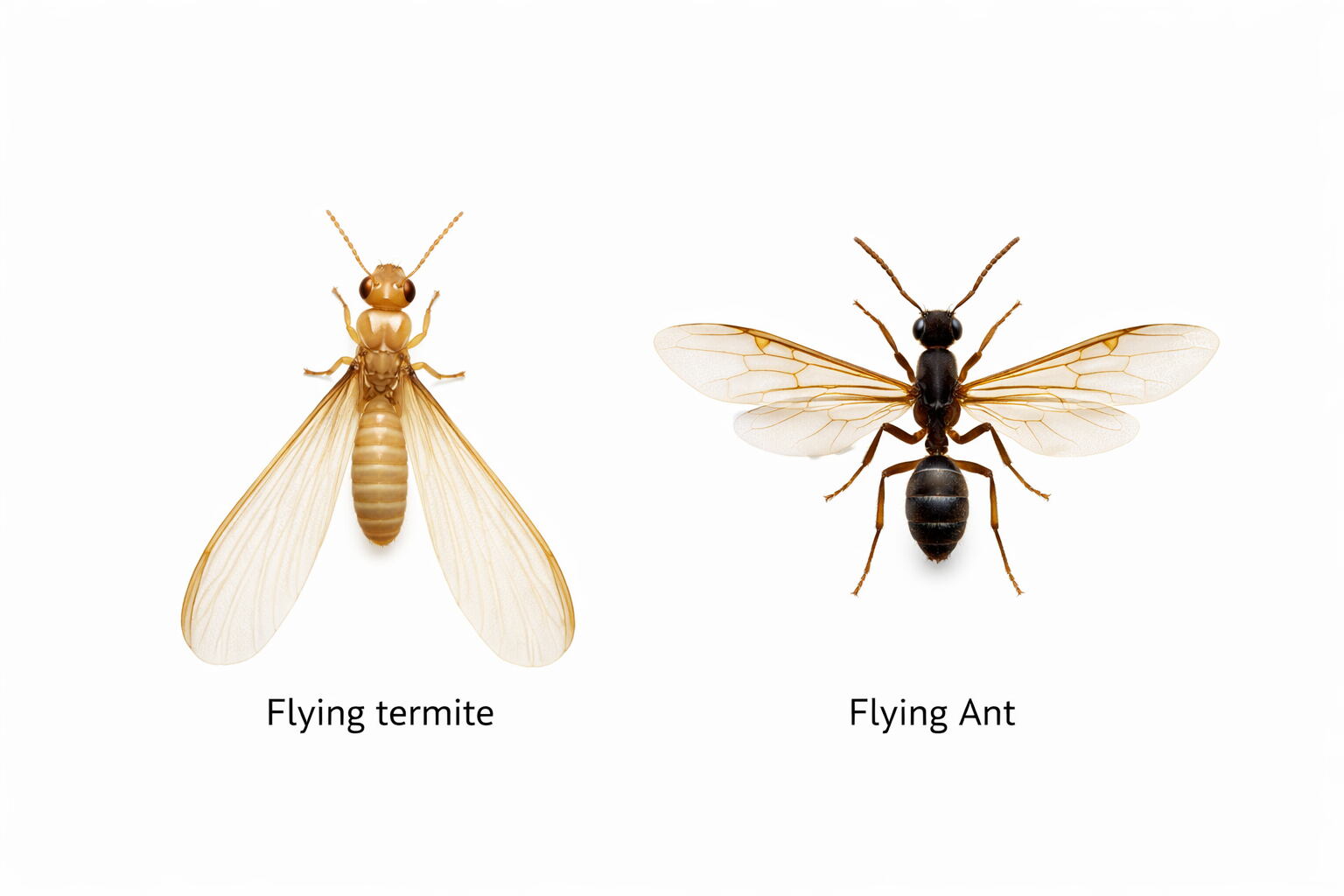
Flying termite versus flying ant comparison — equal-length wings and straight antennae versus unequal wings and bent antennae, UAE villa identification guide

Flying termites (left) have equal-length wings and straight antennae. Flying ants (right) have unequal wings and a distinctly pinched waist. Finding termite wings indoors confirms a nearby established colony.

Sign 5 — Doors and Windows That Suddenly Stick or Drag

If a door that opened freely has recently begun to stick, drag, or require extra force to close, termite damage to the timber frame is a plausible cause — particularly in a Dubai villa where the door frame adjoins an external wall or garden-facing room. Subterranean termites raise moisture as they feed within timber door frames and lintels. This moisture causes the wood to swell and distort, changing the geometry of the frame and causing the door to bind.

However, not every sticking door means termites. High summer humidity can also cause minor seasonal swelling. Therefore, check whether the sticking coincides with any other warning signs — such as a hollow sound when tapping the frame, or a mud tube nearby. If two or more signs are present together, the case for professional inspection is compelling.

Sign 6 — Discarded Wings Near Windows, Lights, or Sliding Door Tracks

After a swarm event, flying termites land, shed their wings immediately, and begin pairing. Consequently, the wings are left behind in clusters near the points of entry — typically on windowsills, inside sliding door tracks, near external light fittings, and on the floor directly beneath indoor light fixtures. Termite wings are all exactly the same length and have a distinctive veined, translucent appearance. They are slightly larger than a mosquito wing but much smaller than a moth wing.

Furthermore, wing piles near internal lights are a particularly significant finding. They suggest that swarmers entered the villa through existing gaps or cracks in the building envelope — which means termite foraging activity has already reached the interior of the structure. Call a specialist as soon as you find internal wing accumulations. Do not sweep them away before photographing them.

Sign 7 — Clicking or Rustling Sounds in Walls or Ceilings at Night

This is the most alarming — and most often dismissed — warning sign. At night, when the villa is quiet, active termite colonies produce a faint but distinct clicking or rustling sound from within walls, ceiling voids, or timber elements. This sound is produced by soldier termites, who tap their heads against tunnel walls to warn the colony of a disturbance. Additionally, the movement of thousands of worker termites through their galleries produces a faint dry rustling.

Press your ear against a wall surface that produced a hollow knock during your tap test and listen for 30 seconds. Similarly, place your ear against a skirting board at the point where it meets a column base or external wall corner. If you hear a faint crackling, clicking, or dry rustling, the colony is active and close to the surface.

6 Places to Check Right Now in Your Dubai Villa

Generic advice tells you to check for termites around the home. However, Dubai villa construction creates six specific high-risk locations that every villa owner should know. Check these zones in order — starting outside and moving inward.

1
Garden Perimeter — Boundary Walls, Planter Bases, and Column Footings
Walk your entire garden perimeter and examine the base of every boundary wall, column footing, and raised planter box. Look specifically at the joint between the soil surface and rendered masonry — this is where mud tubes first appear as termites ascend from their underground colony to the structure above. Additionally, check the base of any palm tree or large shrub planted within two metres of the boundary wall. Furthermore, inspect around any garden tap connections or irrigation pipe outlets — the consistent moisture at these points draws subterranean termites directly.
What to look for: Pencil-width mud tubes, soil disturbance in regular patterns along wall bases, soft or crumbling render at low level.
2
Parquet and Timber Flooring Throughout the Villa
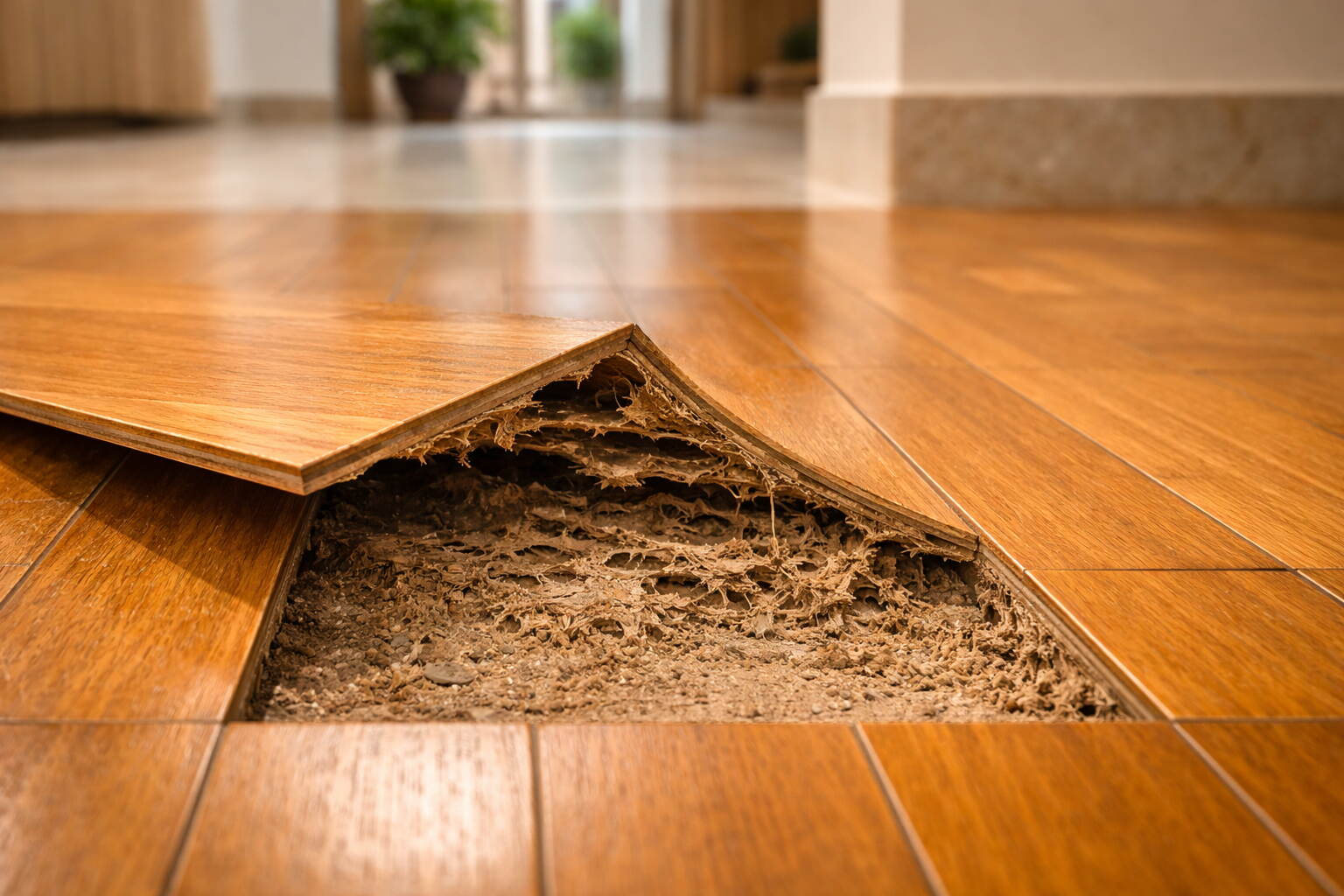
Parquet flooring is one of the most commonly termite-damaged surfaces in Dubai villas. The timber tiles sit directly above a sub-floor void connected to the building perimeter — giving subterranean termites a direct feeding path from garden soil to the floor surface above. Moreover, because termites feed on the underside of the parquet tiles without disturbing the surface, the damage advances silently. Walk slowly across all parquet areas and press down firmly with your foot every half-metre. Any section that feels spongy, bouncy, or noticeably different from the surrounding floor has potential sub-surface damage. Furthermore, tap individual tiles with a coin — a hollow return from a tile that should be solid confirms termite feeding underneath.
What to look for: Spongy or uneven floor sections, tiles that lift without adhesive resistance, tiny cracks appearing at grout lines in areas adjacent to external walls.
3
Kitchen Cabinets and Bathroom Vanities
Kitchen and bathroom joinery is particularly vulnerable in villas where these rooms adjoin external walls or share a wall with a garden-facing utility area. Subterranean termites reach cabinet bases and vanity units through the wall cavity or sub-floor void and feed on the MDF or plywood carcass from the inside. Drywood termites may additionally establish inside solid timber cabinet doors and drawer fronts. Open every lower cabinet and look along the inside base panels — check for frass accumulations, mud tube traces, and any discolouration or softness in the panel material.
What to look for: Frass pellets at the back corners of base cabinets, discolouration or bubbling on cabinet back panels, soft or sunken areas when pressing on the base board inside the cabinet.
4
Built-in Wardrobes and Bedroom Joinery
Built-in wardrobes in Dubai villas are typically constructed from MDF or plywood carcasses with timber veneer or solid timber doors. Both materials are susceptible to termite feeding — MDF particularly so, because it contains organic cellulose binders. Furthermore, the back panel of a built-in wardrobe often sits directly against an external wall, providing a short travel path from the wall cavity to the joinery interior. Empty the bottom section of all wardrobes and examine the back panel and base board with a torch. Additionally, press along the back panel with your thumb — if it flexes noticeably or feels soft, internal feeding may be in progress.
What to look for: Frass accumulations at the base of the wardrobe interior, soft or discoloured back panels, a faint musty earthy smell inside the wardrobe (this can indicate a subterranean colony's soil-packing activity).
5
Under-Stairs Storage and Staircase Timber
The understairs area is one of the most consistently overlooked locations in a villa termite inspection — and one of the highest-risk. In many Dubai villas, the staircase structure includes timber stringers, treads, and risers, and the understairs void is used for storage. This enclosed, rarely disturbed area provides ideal concealment for a growing colony. Moreover, the staircase typically runs along an interior wall that connects to the external ground-floor perimeter. Consequently, subterranean termites can ascend from the garden soil into the staircase timber without passing through any visible open space. Tap every individual stair tread and riser, and shine a torch into the understairs void to check wall surfaces and any timber elements inside.
What to look for: Hollow-sounding treads, mud tubes on the internal walls of the understairs void, soft or crumbling timber at the base of stair stringers.
6
Roof Space, Fascia Boards, and Timber Pergola Structures
If your Dubai villa has a timber pergola, wooden sunshade structure, or exposed timber fascia boards at roof level, these elements are at risk from both subterranean and drywood termites. Additionally, any accessible roof void that contains timber battens or wooden roof structure elements should be checked annually. Drywood termites frequently enter roof spaces through unprotected timber ends and ventilation gaps, establishing colonies in roof battens that can remain undetected for years. Check all external timber elements for frass accumulations below them, hollow sounds on tapping, and any surface pitting or exit holes.
What to look for: Frass piles on roof terraces beneath timber pergola beams, surface pitting or small circular exit holes in fascia boards, wood that crumbles when pressed firmly at corners.
Termite damage to parquet flooring in a Dubai villa — lifted tile revealing hollow cavity and thin brittle damaged wood beneath

Parquet flooring in Dubai villas sits above a sub-floor void connected to the garden perimeter — making it one of the most commonly termite-affected surfaces, and the hardest to detect until damage is advanced.

✅ Termite Warning Signs Checklist: 10 Things to Check in Your Dubai Villa Today

  1. Mud tubes (pencil-width brown soil channels) on the base of any exterior or interior wall, column, or garden boundary structure.
  2. Hollow sound when tapping door frames, skirting boards, stair treads, kitchen cabinet bases, or built-in wardrobe panels.
  3. Frass piles (tiny pale hexagonal pellets resembling fine sawdust) at the base of any timber fitting, furniture, or window frame.
  4. Paint that blisters, bubbles, or peels at low level on interior walls — particularly near door frames and external-wall corners.
  5. Parquet floor sections that feel spongy, bounce slightly underfoot, or produce a hollow return when tapped with a coin.
  6. Doors or windows that have recently begun to stick, drag, or require extra force — combined with a hollow sound on the frame.
  7. Discarded wings — equal-length, translucent, veined — found in piles near windowsills, sliding door tracks, or indoor light fittings.
  8. A cloud of small winged insects appearing near outdoor lights after rainfall, particularly in spring (March–June).
  9. Clicking or dry rustling sounds from inside a wall, skirting board, or ceiling void during quiet evening or nighttime hours.
  10. A faint earthy or musty smell inside a built-in wardrobe or understairs cupboard with no obvious source of moisture.

Spotted Any of These Signs?

Don't wait. Supernova's DM-licensed termite specialists offer free villa inspections across Dubai — including thermal imaging to find hidden colonies.

📲 Book Your Free Termite Inspection

What to Do If You Spot a Warning Sign

Many villa owners make one of two mistakes when they spot a potential termite sign: they either panic and spray pesticide on the area, or they convince themselves it is nothing and wait to see what happens. Both responses make the situation worse. Here is exactly what to do — and what not to do — the moment you find something suspicious.

📸

Photograph It — Before Touching Anything

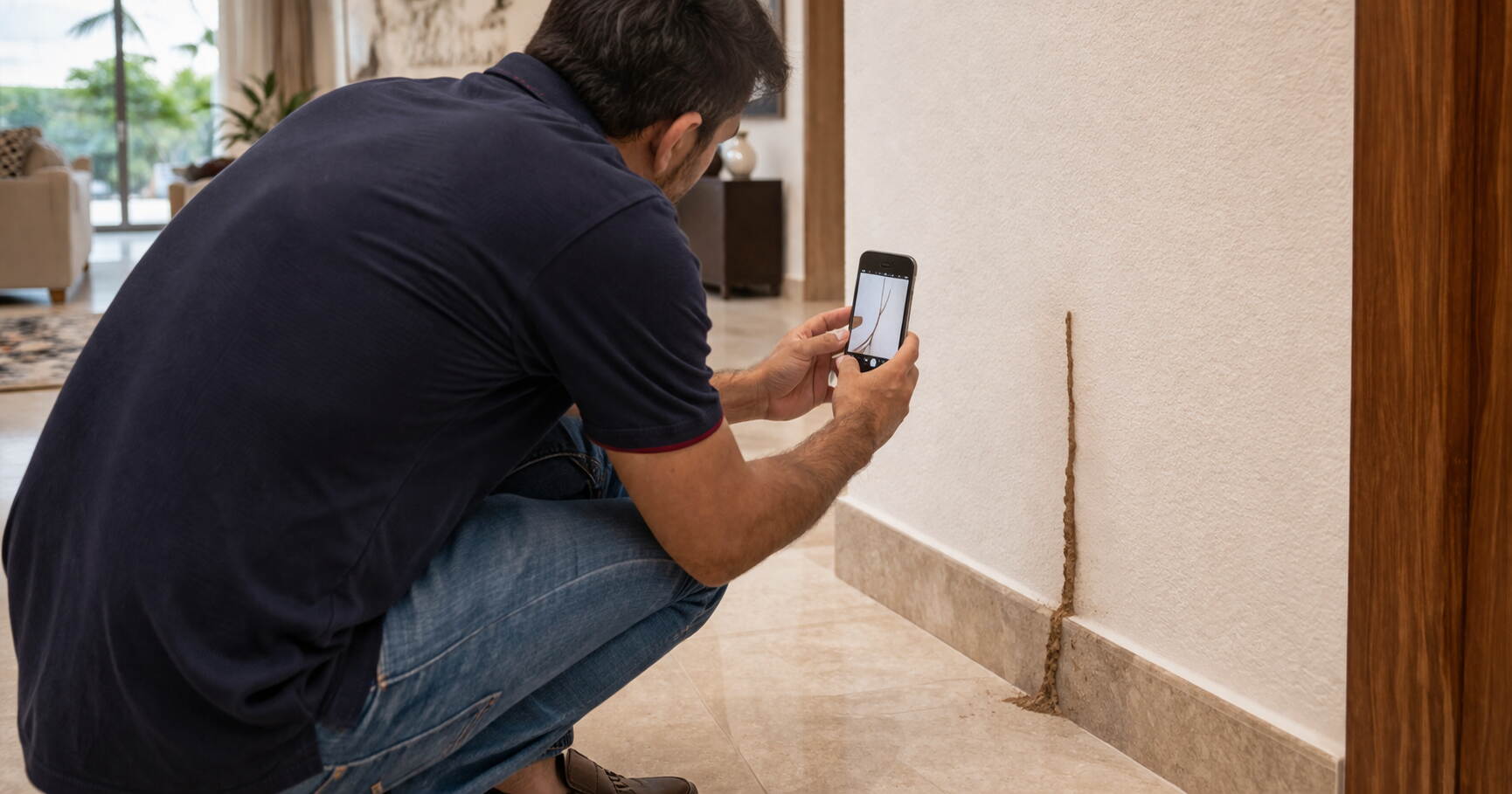
Take clear photographs of the warning sign from multiple angles before doing anything else. Include a coin or a pen in the frame for scale. These photographs help a specialist confirm the species and assess colony activity before they even arrive. Furthermore, photographing the location clearly saves inspection time and ensures the technician goes directly to the right area.

🚫

Do Not Spray, Scrape, or Disturb the Area

Spraying a supermarket insecticide on a mud tube or a frass pile destroys the evidence a specialist needs to diagnose the infestation correctly. Moreover, spraying a repellent product near an active subterranean colony causes the colony to disperse and re-route — splitting one problem into many and making professional treatment significantly harder. Leave the area exactly as you found it.

📞

Call a DM-Licensed Specialist Within the Week

Only a Dubai Municipality licensed pest control company can legally carry out termite treatments in Dubai. Book an inspection within seven days of spotting your first warning sign — not at the next convenient time. A free inspection visit costs nothing. Waiting three additional months while the colony expands can cost tens of thousands of dirhams in repairs.

🔬

Ask for Thermal Imaging — Not Just a Visual Check

A visual inspection alone will miss any colony activity that is behind wall plaster, beneath parquet tiles, or inside ceiling voids. Ask specifically for a thermal imaging survey. This non-invasive technique detects the heat and moisture signature of active colonies without any destructive access. Additionally, ask for a written report with your photographs and treatment recommendations — do not accept verbal-only feedback.

Homeowner crouching to photograph a termite mud tube at the base of an interior wall in a Dubai villa with their smartphone

Photograph the warning sign clearly before touching anything — this single step makes a significant difference to the speed and accuracy of specialist diagnosis.

Supernova's anti-termite treatment service for Dubai villas includes a free inspection, thermal imaging survey, and a written treatment report with photographs — all at no cost until you confirm treatment. For ongoing protection after treatment, our annual pest control contract includes scheduled termite inspections to ensure barrier integrity and catch any new activity early. Additionally, if you have recently read our guide on termite damage in commercial buildings, you will recognise that many of the same principles apply to the built-in joinery and suspended elements of large Dubai villas. For a full overview of what Supernova covers across Dubai communities, visit our pest control services page.

Frequently Asked Questions — Termite Signs in Dubai Villas

What are the earliest signs of termites in a Dubai villa?
The earliest signs are usually mud tubes on garden boundary walls or column bases, and frass pellets at the base of timber door frames or skirting boards. Additionally, a spongy or bouncy feel underfoot on parquet flooring sections near external walls can indicate sub-surface feeding that has not yet produced any visible surface damage. Furthermore, a faint earthy smell inside built-in wardrobes that adjoin external walls is sometimes the first clue a homeowner notices before any visible sign appears.
How do I know if the mud tube I found is active or abandoned?
Carefully break a small section of the mud tube — approximately 1cm — at a point in the middle of the tube and leave it for 24 hours. If the tube is rebuilt or repaired at that break point within 24 hours, the colony is active. If the break remains open with no repair, the tube may be abandoned. However, even an apparently abandoned tube warrants professional investigation. Termites routinely build alternative routes when their primary tube is disturbed, and the colony may still be feeding nearby through a different pathway.
Do I have termites if I find discarded wings inside my villa?
Finding discarded wings indoors is strong evidence of a nearby established termite colony. Flying termite swarmers are released by mature colonies — the colony must already be established and at reproductive maturity to produce swarmers. Furthermore, finding wings indoors specifically means that swarmers entered the villa through an existing gap or crack in the building envelope, suggesting that termite foraging activity has already reached the interior of the structure. Collect a sample of the wings in a sealed bag and contact a pest control specialist the same day. Supernova's free termite inspection can confirm the species from wing samples.
Can termites damage parquet flooring in a Dubai villa?
Yes — parquet flooring is one of the most commonly termite-damaged surfaces in Dubai villas. Subterranean termites reach the underside of parquet tiles through the sub-floor void connected to the garden perimeter. They consume the timber from beneath, leaving only a paper-thin surface shell. The first signs are often sections that feel spongy underfoot, individual tiles that lift without adhesive resistance, or a hollow return when tapping tiles with a coin near external walls. Parquet replacement after advanced termite damage is expensive — a single room can cost AED 8,000–25,000 or more to restore.
When is termite swarm season in Dubai?
Termite swarming in Dubai typically occurs in spring and early summer — most commonly between March and June. Swarms are frequently triggered by rainfall. After a rainstorm, if you notice a large number of small winged insects appearing near outdoor lights or entering your villa through window gaps, it is very likely a termite swarm event. Furthermore, due to climate shifts across the UAE, swarm activity has been observed slightly earlier in the calendar year in recent seasons. However, because colonies feed year-round in Dubai's warm climate, termite damage occurs in all seasons — not only during swarm periods.
How much does termite treatment cost for a Dubai villa?
Treatment costs for a Dubai villa depend on the villa size, species identified, infestation severity, and the treatment method required. Post-construction anti-termite treatments — which include targeted injection, baiting systems, or localised soil treatment — are significantly less expensive than structural repairs caused by delayed treatment. The cost-comparison that matters most: a professional termite treatment visit for a typical Dubai villa typically costs a fraction of the parquet replacement, door frame restoration, and plaster reinstatement that follows an untreated infestation. Supernova offers a free inspection with a written treatment quotation at no obligation.
Is it safe to stay in my villa while termite treatment is carried out?
In most cases, yes — modern termite treatments used by DM-licensed companies in Dubai are designed to be applied with minimal disruption to the household. Localised injection treatments and gel bait applications can be carried out while the villa is occupied with standard precautions, such as keeping children and pets away from treated areas during application. However, if a whole-structure fumigation is recommended for a severe drywood infestation, the villa would need to be vacated for the treatment duration. Your specialist will advise clearly on occupancy requirements before treatment begins.
How can I prevent termites from returning after treatment?
After treatment, the most effective preventive measures are: maintaining a gap of at least 30cm between garden soil and any timber building element; reducing irrigation near the building perimeter where possible; storing firewood and timber materials off the ground and away from the villa structure; keeping the garden free from dead tree stumps and large root systems within 10 metres of the building; and booking an annual inspection to check barrier integrity. Furthermore, an annual pest control contract with Supernova includes scheduled termite inspections as part of a complete villa protection programme.

🪲

Supernova Technical Team

Supernova Pest Control is a Dubai Municipality licensed pest control company providing free termite inspections, thermal imaging surveys, and anti-termite treatments for villas across all Dubai communities. Our team has treated termite infestations in villa communities across Jumeirah, Arabian Ranches, The Springs, Mirdif, Al Barsha, and beyond. Book your free villa inspection →

Anti-Termite Treatment Locations in Dubai